

Flip over a fine mechanical watch, peer through the sapphire caseback, and you'll notice tiny flecks of red glinting among the gears—small crimson dots set into gold-colored rings, scattered across the movement like garnets in a mine. Those are jewels. Real synthetic rubies, precisely drilled and polished, doing one of the most important and least understood jobs in all of horology.
They aren't there for decoration, though watchmakers have long enjoyed the way they sparkle. Those rubies are bearings, and they solve a problem that plagued mechanical timekeeping for centuries: friction. Here's how a gemstone became the unsung hero inside every serious wristwatch.
The Problem: Metal Grinding on Metal
A mechanical watch is, at its heart, a system of tiny wheels spinning on even tinier axles called pivots. The balance wheel alone oscillates roughly 28,800 times per hour in a modern movement—that's eight beats per second, day and night, for years. Every one of those oscillations means a pivot rotating inside a hole.
When metal pivots spin in metal holes, three bad things happen. Friction robs the movement of energy, meaning the mainspring's power dissipates before it can drive the hands accurately. Heat and wear gradually enlarge the holes, throwing off the geometry that keeps time. And the lubricating oil breaks down faster against rough metal surfaces. Over time, an all-metal movement wears itself into inaccuracy and eventually failure.
Enter the Gemstone
The insight—radical for its era—was that a hard, smooth gemstone makes a far better bearing surface than steel or brass. Ruby and sapphire (both corundum, just different colors) rank 9 on the Mohs hardness scale, second only to diamond. They resist wear almost indefinitely, they hold oil beautifully, and they can be polished to a mirror finish that reduces friction to a whisper.
An English Invention, a Swiss Tradition
The story begins in 1704, when three men working in London—Nicolas Fatio de Duillier, a Swiss mathematician, alongside brothers Peter and Jacob Debaufre—patented the use of pierced jewels as watch bearings. Fatio had figured out how to drill natural rubies and sapphires precisely enough to accept a steel pivot. It was a genuine breakthrough, and for decades English watchmakers guarded the technique as a competitive secret.
Natural gemstones, however, were expensive and inconsistent. The real democratization came in 1902, when French chemist Auguste Verneuil perfected a process for growing synthetic corundum by melting aluminum oxide powder in an oxyhydrogen flame. Suddenly, flawless rubies could be manufactured in quantity for pennies. The synthetic jewel wasn't a cheap substitute—chemically it's identical to a mined ruby, and often purer, with fewer inclusions to compromise the bearing surface.
Where the Jewels Live
Jewels aren't scattered randomly. Each type sits precisely where it earns its keep, and understanding the varieties reveals just how thoughtfully a movement is engineered.
Hole Jewels
The most common type, these are doughnut-shaped rings with a central hole that acts as the bearing for a pivot. They're used throughout the gear train wherever a wheel needs to spin freely.
Cap Jewels (Endstones)
These flat, solid jewels sit on top of hole jewels at the most critical points—especially the balance staff. They limit the pivot's end-play and create a tiny reservoir that holds lubricating oil right where it's needed. Together, a hole jewel and cap jewel form the elegant assembly you'll see cradling the balance wheel.
Pallet Jewels and the Impulse Jewel
In the escapement—the mechanism that doles out energy in precise increments—rubies do the heaviest lifting. Two rectangular pallet stones on the pallet fork catch and release the escape wheel's teeth thousands of times an hour. A single cylindrical impulse jewel (the "roller jewel") transfers energy to the balance. These are the hardest-working jewels in the watch, absorbing constant impact, and gemstone is the only material tough enough to survive it.
The Numbers Game: What "17 Jewels" Actually Means
You've probably seen movements advertised as "17 jewels" or "21 jewels." For a time-only mechanical watch, 17 is the classic fully-jeweled count: it covers the balance, escapement, and gear train down to the center wheel. It became such a benchmark that "17 jewels" was practically a badge of quality on mid-century dials.
More jewels aren't automatically better, though. Complications add legitimate jewel counts—an automatic winding system, a chronograph, or a calendar mechanism each introduce new pivots that benefit from jeweling. A perpetual calendar chronograph might genuinely need 40 or more. But in the 1960s, some manufacturers began stuffing decorative, non-functional jewels into movements purely to inflate the number on the dial. The practice got bad enough that regulators stepped in: today, a jewel can only be counted if it serves a real mechanical function.
This kind of honest, purpose-driven construction is exactly what separates thoughtful independent watchmaking from marketing theater—a philosophy you can see throughout the Grandeur USA collection, where every component earns its place.
How a Watch Jewel Is Made
Turning a boule of synthetic corundum into a functioning bearing is a marvel of micro-engineering. The grown crystal is sliced into thin wafers, then cut into tiny cylinders. Each is ground and shaped, and the critical hole is drilled—historically with diamond-tipped tools, today often with lasers—to tolerances measured in microns. The hole is then given an olive-shaped profile, subtly curved so the pivot touches only a minimal band of surface, reducing friction further still. Finally, the jewel is polished until its bearing surfaces gleam.
The finished jewel is pressed into the movement plate or bridge, either into a machined seat or a gold chaton (a small ring that holds the jewel and can be screwed into place). Those gold rings around the rubies on a high-end movement aren't just pretty—they're a traditional, serviceable way of mounting jewels that many collectors prize.
Why It Still Matters
You might ask whether jewel bearings still matter in an age of quartz and smartwatches. For mechanical horology, the answer is absolutely. A well-jeweled movement can run for decades between services and, with proper care, effectively forever. The same physics that made Fatio's rubies revolutionary in 1704 still governs the watch on your wrist today.
So the next time you catch that flash of red through a caseback, remember: you're looking at three centuries of accumulated ingenuity, distilled into a gemstone smaller than a grain of rice—quietly doing its job, one oscillation at a time.
Featured Watch
Grandeur Center Tourbillon
The jewels doing the hardest work in any watch live in the escapement—and there's no better place to admire that engineering than through the open architecture of a tourbillon.
Explore Center Tourbillon →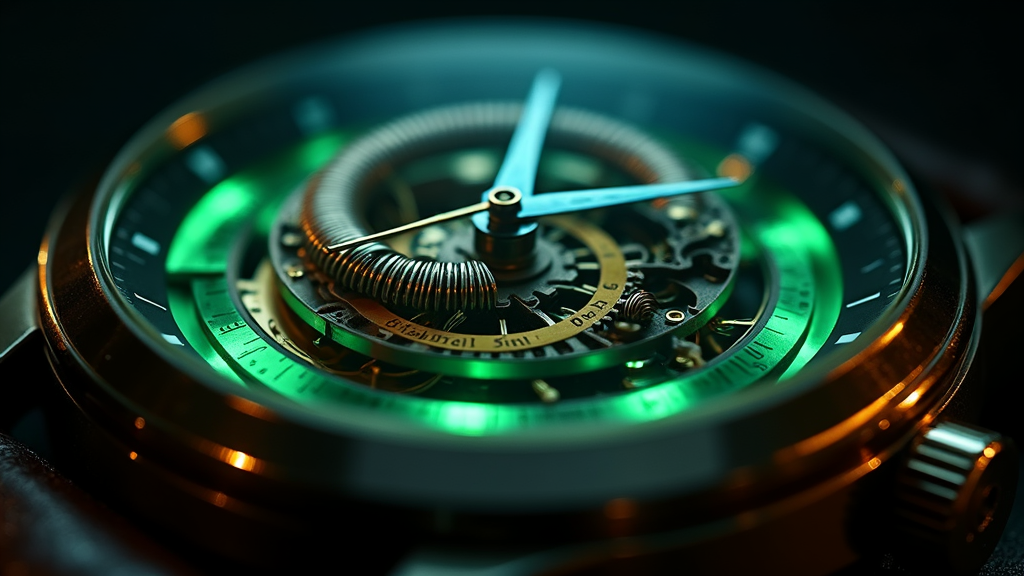

Leave a comment
This site is protected by hCaptcha and the hCaptcha Privacy Policy and Terms of Service apply.