
For four centuries, every watch worth wearing kept time the same way: a spring pushed a wheel, a wheel nudged an escapement, and an escapement let a balance swing back and forth. Tick. Tock. It was mechanical poetry, and it was also the source of every mechanical watch's limitations. Then, in 1960, a company famous for affordable American wristwatches did something nobody expected. Bulova replaced the entire swinging heartbeat of the watch with a humming metal fork the size of a fingernail, and in doing so built the most accurate wristwatch the world had ever seen.
The Accutron didn't tick. It hummed at 360 cycles per second, and for a brief, brilliant window before quartz swept everything away, it was the future of timekeeping.
The Problem With Swinging
To understand why the Accutron mattered, you have to understand what it replaced. In a traditional mechanical watch, timekeeping accuracy depends on the balance wheel — a small weighted ring that oscillates back and forth, typically at somewhere between 18,000 and 28,800 vibrations per hour. Every swing is metered out by the escapement, and every swing is subject to interference: gravity pulling on the balance, temperature changing the metal, shocks jarring the assembly, and the gradual decay of lubricants.
The faster and more consistently something oscillates, the more precisely it can divide time. But a mechanical balance wheel has a ceiling. Push it too fast and friction, wear, and power consumption spiral out of control. Watchmakers spent generations refining the balance to squeeze out fractions of a second per day. What Bulova's engineers realized was that the entire premise — a swinging mass regulated by an escapement — might be the wrong approach altogether.
Enter Max Hetzel
The Accutron was the work of Max Hetzel, a Swiss-born engineer who joined Bulova's operations in the early 1950s. Hetzel was fascinated by a component that had nothing to do with watchmaking: the tuning fork, the humble two-pronged tool musicians use to find a reference pitch. A tuning fork has a remarkable property. When struck, it vibrates at an extremely stable, precise frequency determined by its shape and material — and it resists the disturbances that plague a balance wheel. Orientation barely affects it. Small shocks don't derail it.
Hetzel's question was deceptively simple: what if the tuning fork was the regulator? What if, instead of a swinging wheel, a watch used a constantly humming fork to slice time into fantastically small, stable pieces?
How the Accutron Worked
The engineering answer took most of the 1950s to perfect. At the heart of the Accutron sat a tiny tuning fork, roughly a centimeter long. To keep it vibrating, Hetzel used a transistor circuit powered by a single small battery — the Accutron was, notably, one of the first consumer products to rely on the transistor, a technology barely a decade old at the time.
Two miniature electromagnetic coils kept the fork oscillating at a steady 360 hertz. That frequency was the magic number: far higher and more stable than any mechanical balance could manage. But a humming fork doesn't turn hands. So Hetzel devised an ingenious translation system. One tine of the fork carried a microscopic pawl — a jeweled finger — that engaged an index wheel bristling with 320 teeth, each tooth so fine it was invisible to the naked eye. With every vibration, the pawl advanced the wheel by a single tooth, converting 360 tiny pushes per second into smooth, continuous rotation of the gear train.
The result was a second hand that didn't tick or even sweep in the conventional sense — it glided, perfectly smooth, because the underlying motion was 360 imperceptible nudges every second. And the watch made a sound no mechanical timepiece ever had: a soft, continuous electric hum.
Accuracy That Redefined Expectations
Bulova guaranteed the Accutron to within two seconds per day — roughly a minute a month. For 1960, that was staggering. A very good mechanical watch of the era might drift five to ten seconds a day; a chronometer-certified piece did better but cost a fortune and still couldn't match the fork. The Accutron wasn't just competitive with the finest Swiss mechanicals. It embarrassed them, and it did so at a price ordinary professionals could afford.
The Watch That Went Everywhere Important
The Accutron's precision made it the instrument of choice for missions where seconds mattered. Accutron movements were installed in the instrument panels of Air Force One during the Kennedy administration. NASA relied on Accutron timing mechanisms in the equipment carried aboard the earliest space missions, and Accutron technology flew on satellites where a mechanical watch's lubricants would have frozen and failed.
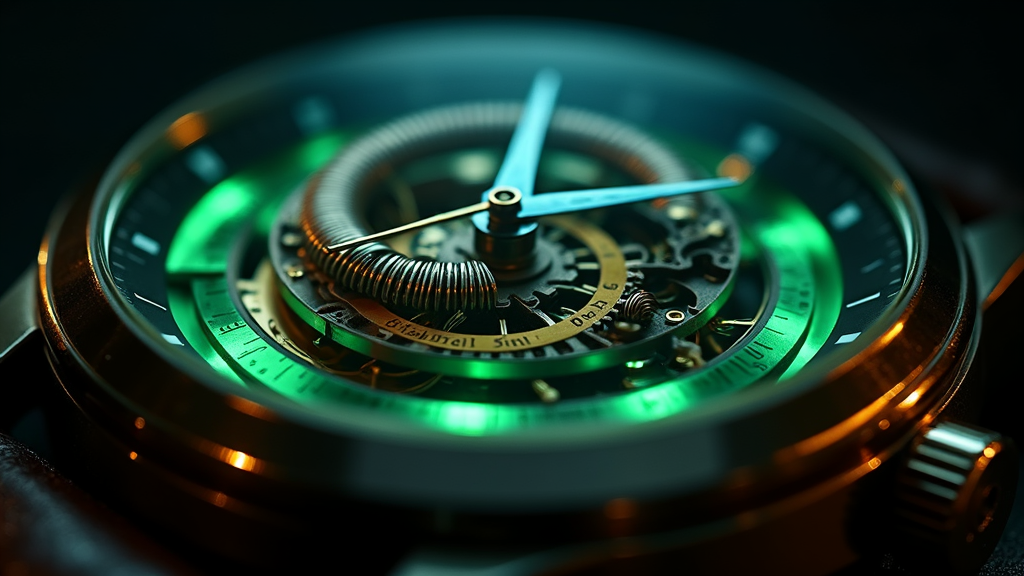
On Earth, the Accutron became a status object with a twist. It looked futuristic — especially the famous "Spaceview" models, which put the humming fork and glinting circuitry on full display behind a transparent dial. Owning one signaled that you were on the right side of technological history. It hummed on the wrists of astronauts, presidents, and engineers who understood exactly what they were wearing.
The Accutron's obsession with visible, honest mechanism is a philosophy Grandeur shares. There's a particular thrill in a watch that shows you how it works rather than hiding it behind a solid caseback — the same open-hearted transparency you'll find in the sculptural architecture of the Grandeur Center Tourbillon, where the beating regulator sits center stage for all to see.
The Sunset: How Quartz Ended the Hum
Here is the poignant part of the Accutron story. The tuning fork was a revolution — but it was a transitional one. The same march of electronics that made the transistor-driven fork possible was about to produce something even better.
A tuning fork hums at 360 hertz. A quartz crystal, when stimulated by an electric current, vibrates at 32,768 hertz — nearly a hundred times faster and even more stable. In 1969, less than a decade after the Accutron's debut, Seiko launched the Astron, the first commercial quartz wristwatch. Quartz was more accurate, cheaper to mass-produce, and had no delicate mechanical pawl and index wheel to assemble by hand. The economics were brutal and one-directional.
Bulova produced tuning-fork movements into the 1970s, but the writing was on the wall. The very electronic future the Accutron had announced arrived and rendered it obsolete. The fork fell silent, replaced by the crystal that still governs nearly every non-mechanical watch made today.
Why Collectors Still Chase the Hum
Today the Accutron occupies a beloved niche in horological history. Vintage Spaceview models are prized precisely because they represent a road not fully traveled — a moment when watchmaking briefly imagined an electromechanical future before leaping past it to pure electronics. Servicing them requires specialists who understand the microscopic index wheel and the aging transistor circuits, and a well-restored example still delivers that unmistakable, uncanny smooth glide of the seconds hand.
The Accutron reminds us of something worth remembering in an age of smartwatches: that innovation isn't always a straight line, and that some of the most fascinating machines ever built were the beautiful, brilliant dead ends. For twenty years, the most accurate way to carry time on your wrist wasn't a tick or a tock. It was a hum.
Featured Watch
Grandeur Center Tourbillon
Like the Accutron's transparent Spaceview, the Center Tourbillon puts its beating heart on full display — an open invitation to watch precision happen in real time.
Explore Center Tourbillon →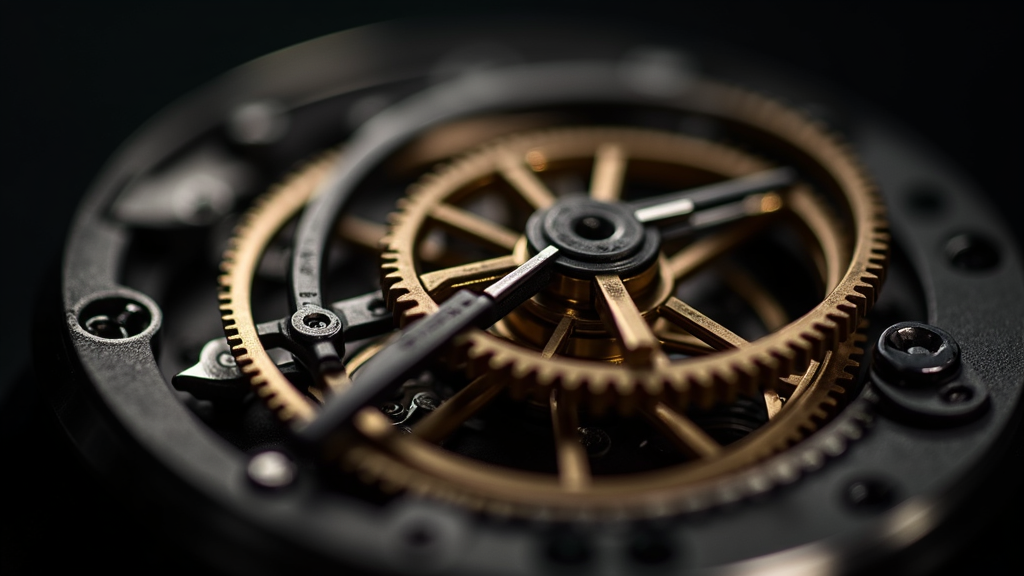


Leave a comment
This site is protected by hCaptcha and the hCaptcha Privacy Policy and Terms of Service apply.