
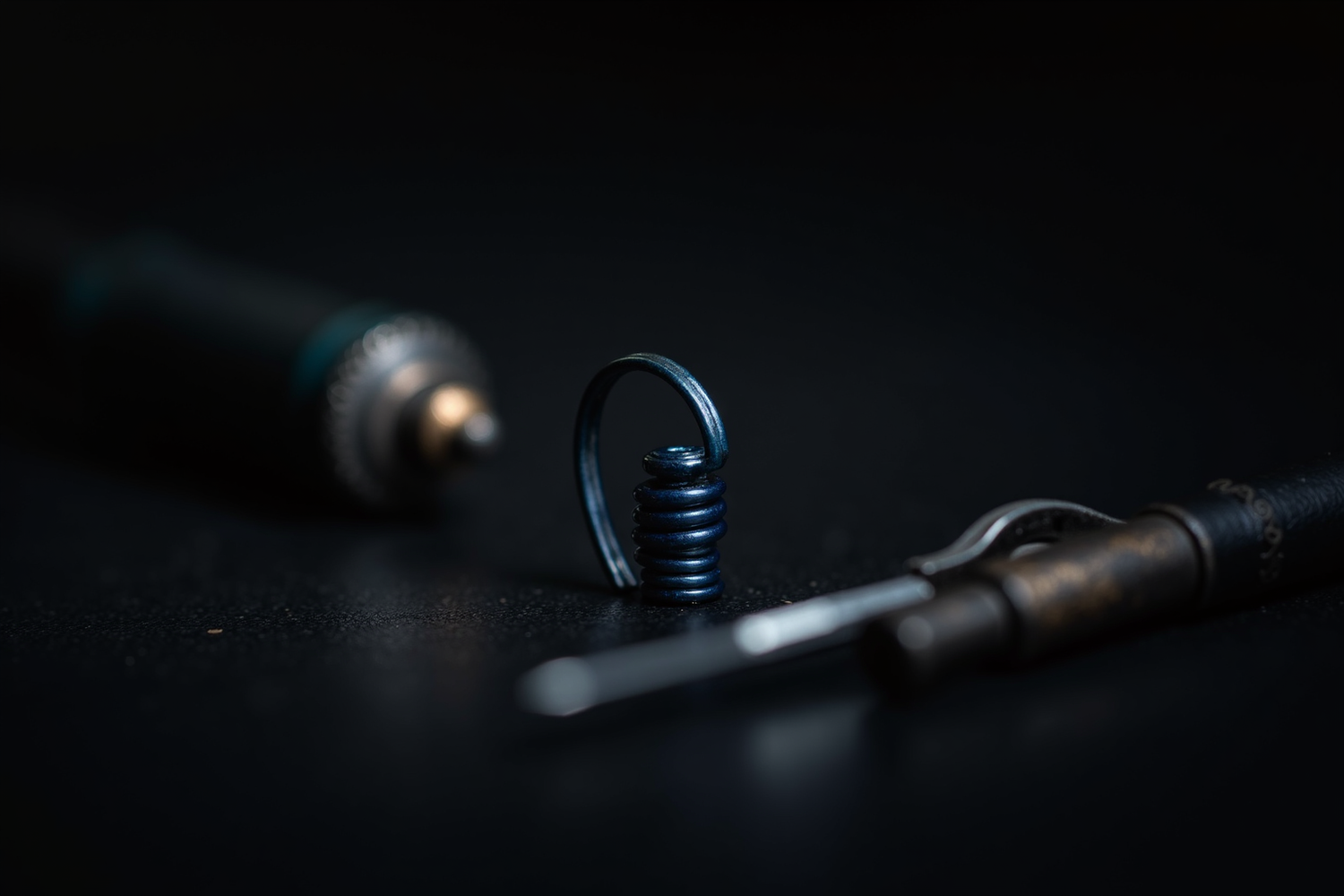
Inside every mechanical watch, a microscopic coil of metal — thinner than a human hair, lighter than a grain of rice — flexes thousands of times an hour to make time itself measurable. It is called the hairspring, and despite weighing roughly 0.05 grams, it is the single most important component in horology. Get it wrong, and the most expensive movement on earth becomes an ornament. Get it right, and a chunk of brass and steel can keep pace with the cosmos.
What a Hairspring Actually Does
A mechanical watch tells time by counting oscillations. The mainspring stores energy; the gear train transmits it; the escapement releases it in tiny, regular bursts. But what controls the rhythm of those bursts? The balance wheel, a small flywheel that rotates back and forth — and the hairspring is what makes it return.
Think of it like a child on a swing. The balance wheel is the swing; the hairspring is gravity. Without the spring's restoring force, the wheel would drift off and stop. With it, the wheel oscillates at a precisely tuned frequency — typically 4 Hz in a modern movement, meaning eight beats per second, or 28,800 per hour. That tick-tick-tick you hear inside a fine watch is the hairspring breathing in and out, pacing the entire machine.
The Numbers Behind the Magic
- Length: Coiled, about 3-4 mm across. Stretched out, roughly 30 cm.
- Thickness: Around 30 microns — about a third the width of a human hair.
- Weight: Approximately 0.05 grams.
- Oscillations per day: 691,200 at 4 Hz. Per year: over 252 million.
To put that in perspective: a hairspring in a daily-worn watch flexes more times in five years than the human heart beats in a lifetime — and it has to do so without fatigue, without losing shape, without skipping a single beat.
A Brief History of the Spring That Changed Everything
Before 1675, portable timekeepers were notoriously unreliable. The verge escapement, governed only by inertia, drifted by 15 minutes a day on a good run. Then Christiaan Huygens, the Dutch polymath, attached a small spiral spring to the balance wheel — and accuracy improved roughly tenfold overnight.
The hairspring transformed watches from charming jewelry into navigational instruments. Without it, no marine chronometer. Without the marine chronometer, no reliable longitude at sea. Without longitude, no global commerce in any modern sense. It is not an exaggeration to say a coiled wisp of metal helped redraw the map of the world.
Breguet's Overcoil and the Quest for Concentricity
Abraham-Louis Breguet, the patron saint of horological problem-solving, noticed something subtle in the late 1700s: as a flat hairspring expands and contracts, its center of gravity shifts. That shift introduces tiny positional errors — the watch runs differently on its side than it does flat on a table.
His solution, patented in 1795, was the overcoil: the outer terminal curve of the hairspring is bent up and inward, so it breathes concentrically around the balance staff. The geometry is fiddly, the bending requires saintly patience, and to this day a hand-formed Breguet overcoil is considered one of the surest signs of a movement assembled by a real human being. Machines can do it. They just can't do it gracefully.
Why Hairsprings Are So Hard to Make
The hairspring is the only component in a watch that cannot tolerate compromise. A slightly off-tolerance gear loses a fraction of a second a day. A slightly off-tolerance hairspring loses minutes — or stops the watch entirely. Three problems make manufacturing brutal:
1. Material Memory
The metal must flex hundreds of millions of times without losing its shape. Early hairsprings were made from hardened blued steel — beautiful, but susceptible to magnetism, temperature change, and shock. A walk past a refrigerator magnet could ruin a 1950s Omega.
2. Temperature Sensitivity
Heat softens metal; cold hardens it. A steel hairspring at 35°C beats noticeably faster than the same spring at 5°C. For most of horological history, watchmakers compensated with bimetallic balance wheels — clever, but imperfect. The real fix came from the metallurgy lab.
3. Geometric Perfection
A hairspring must be perfectly flat (or perfectly overcoiled), perfectly concentric, and perfectly equidistant between coils. Push two coils together — say, by handling the spring incorrectly during a service — and timing collapses immediately. This is why watchmakers earn their gray hairs.
The Modern Materials Revolution
Three innovations defined the hairspring's modern era, and each one quietly remade the industry.
Invar and Elinvar (1896, 1920)
Charles-Édouard Guillaume, a Swiss physicist working at the Bureau International des Poids et Mesures, invented two iron-nickel alloys with near-zero thermal expansion. Elinvar, in particular, gave watchmakers a hairspring that didn't care about temperature. Guillaume won the 1920 Nobel Prize in Physics — the only Nobel ever awarded for horology.
Nivarox (1933)
An improved Elinvar formulation that became the industry standard. For the next 70 years, almost every Swiss watch — Rolex, Patek, Audemars Piguet, your grandfather's Omega — relied on Nivarox hairsprings supplied by a single company, the Swatch Group's Nivarox-FAR. A genuine choke point in global watchmaking.
Silicon and Parachrom (2000s)
The silicon hairspring, introduced commercially around 2006, was the first major leap in a century. Etched from a single wafer of silicon using semiconductor lithography, it is utterly antimagnetic, far more resistant to temperature and shock, and so geometrically precise that a Breguet overcoil can be designed in a CAD program rather than bent by hand.
Rolex took a different path with Parachrom — a niobium-zirconium alloy with similar antimagnetic properties but the visual romance of a deep blue patina. Both are extraordinary. Both quietly rewrote what a watch can endure.
For a deep dive into how silicon hairsprings interact with high-complication horology, our Grandeur Center Tourbillon showcases a hairspring spinning inside a rotating tourbillon cage — every component visible, every breath of the spring on full display.
The Hand-Adjuster: Horology's Last Magician
Even with modern materials and machine tolerances, the final regulation of a fine hairspring is still done by a human under a loupe. The régleuse, traditionally a watchmaker (often a woman, in the great Swiss workshops) of extraordinary patience, manipulates the spring micron by micron with a pair of brass tweezers warmed in her hand to avoid thermal shock.
She listens. Yes — listens. A well-trained ear can detect a poorly poised balance by the irregularity of its beat. She adjusts. She tests on a timing machine. She adjusts again. A high-grade movement may pass through her hands for the better part of a day before its rate is acceptable in six positions and across a 24-hour temperature range.
This is the part of watchmaking that no marketing department can fake. It is also the part that, in a world of CNC and laser cutting, persists almost unchanged from the 18th century — because no algorithm has yet matched the sensitivity of a trained human hand on a 0.05-gram coil.
Why It Matters to a Collector
When you appraise a mechanical watch, you are really appraising a hairspring. The case can be replaced. The dial can be restored. The mainspring is a service item. But the hairspring — its material, its geometry, its hand-adjustment — is the soul of the rate. A watch that gains or loses two seconds a day after twenty years of wear is not a miracle of engineering. It is a quiet triumph of one tiny coil, doing its job, breath after breath, year after year.
Next time you hold a fine watch to your ear and hear that steady, almost musical tick, remember: that sound is a 0.05-gram piece of metal flexing and returning, 28,800 times an hour, exactly as it did the day it left the workshop. There is nothing else in your life so small that does so much, so reliably, for so long.
Featured Watch
Grandeur Center Tourbillon
A flying tourbillon at 6 o'clock cradles the hairspring in plain view — the pulse of the watch, magnified and made theatrical, exactly as horology intended.
Explore Center Tourbillon →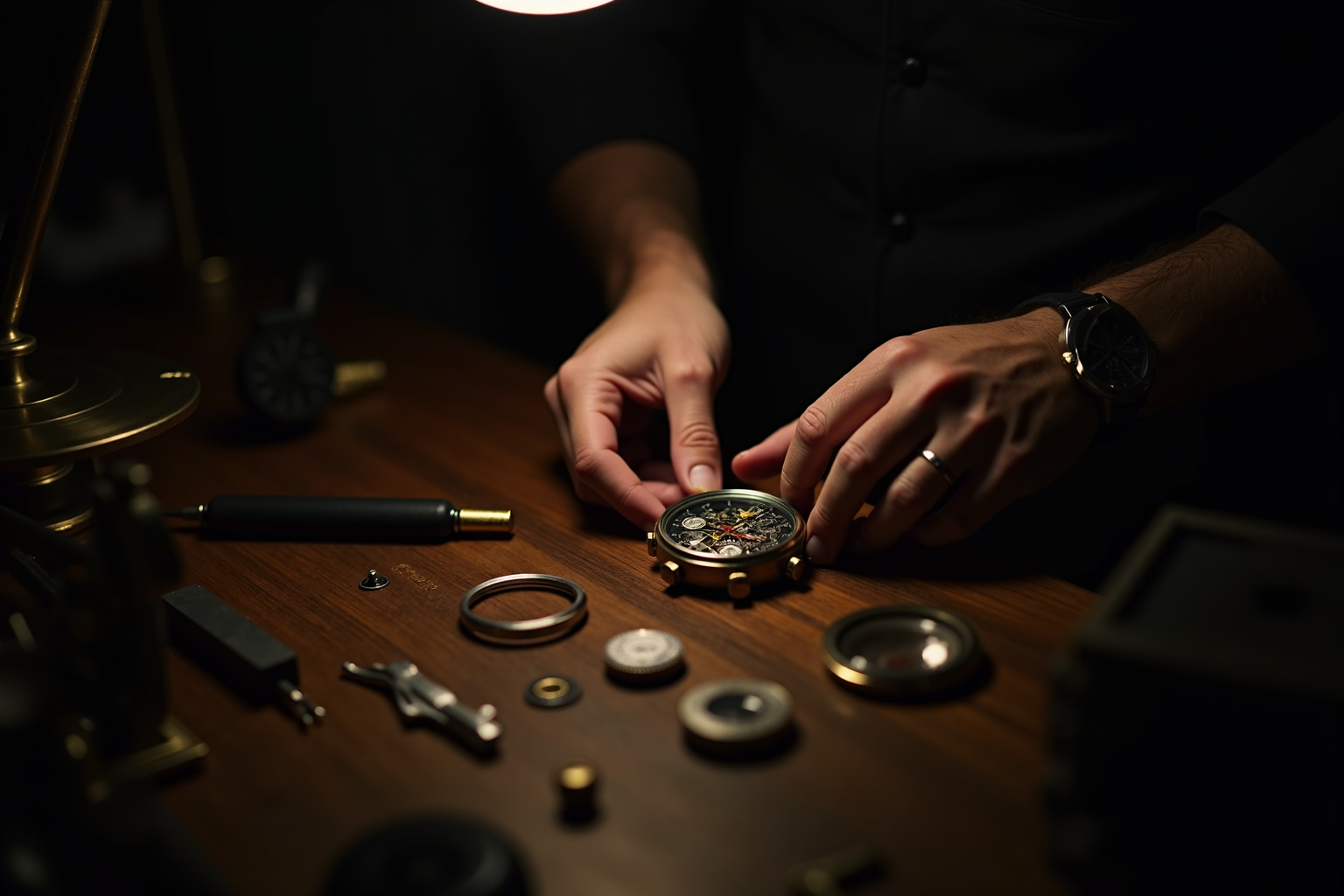

Leave a comment
This site is protected by hCaptcha and the hCaptcha Privacy Policy and Terms of Service apply.