
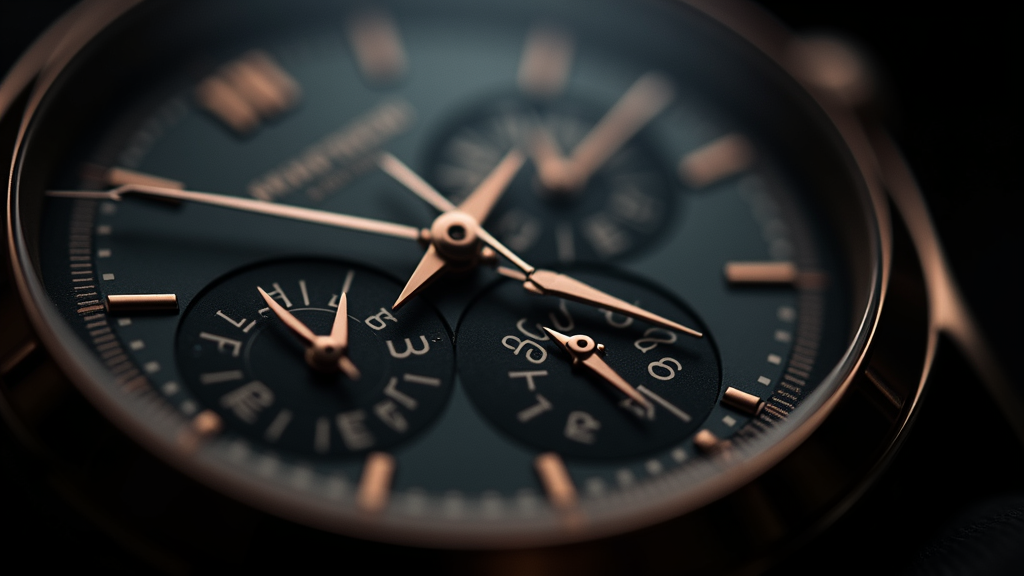
Most watch dials are a beautiful compromise. Three hands sweep across a single track, overlapping, crossing, occasionally hiding one another at the top of the hour. We are so used to this arrangement that we rarely question it. But there is another way — an older, stranger, more deliberate way — and it produces one of the most captivating layouts in all of horology: the régulateur.
On a régulateur dial, the hours, minutes, and seconds each get their own private stage. No overlap. No crowding. Just three independent displays, arranged in a vertical conversation down the face of the watch. To the uninitiated it looks like a design choice. To anyone who knows the history, it is a monument to precision.
What Exactly Is a Régulateur?
A régulateur (French for "regulator") is a dial layout in which the minute hand is given pride of place at the center, while the hours and seconds are relegated to their own smaller subdials — traditionally the hours at 12 o'clock and the small seconds at 6 o'clock. The result is a dial dominated by a single, long, elegant minute hand sweeping over the full face, with two quiet satellites keeping company above and below.
This is the inverse of what most people expect. On a normal watch, the hour hand and minute hand share the center pivot. On a régulateur, only the minutes live there. It is a subtle rearrangement with a profound purpose.
The Logic Behind the Layout
Why break tradition and scatter the hands? Because for the people who first used these clocks, the minute was the most important unit of all — and reading it needed to be instant and unambiguous.
Born in the Observatory, Not the Boutique
The régulateur did not begin as a fashion statement. It began as a tool. In the 18th and 19th centuries, before radio time signals and atomic clocks, the most accurate timekeepers in any city were the precision pendulum clocks kept in astronomical observatories and master clockmakers' workshops. These were the reference clocks — the regulators — against which every other watch and clock in town was set.
A watchmaker setting a client's pocket watch would glance at the regulator on the wall to synchronize the seconds and minutes exactly. For that job, overlapping hands were a liability. If the hour hand crossed the minute hand at the wrong moment, a fraction of a second of hesitation could creep in. So the reference clocks separated the displays: the minutes and seconds — the units that mattered for synchronization — were placed where they could never be confused with anything else.
The name stuck. When wristwatches later borrowed this layout, they inherited both the geometry and the pedigree. Wearing a régulateur is, in a quiet way, wearing a reference to the most accurate clocks of the pre-electronic age.
Reading a Régulateur Takes a Beat
Here is the honest truth that régulateur owners learn quickly: these watches are not built for the impatient glance. On a conventional dial, your eye takes in the rough angle of two hands and instantly approximates the time. On a régulateur, you read it in stages — check the small hours subdial, then the big central minute hand, then the seconds if you care.
This is not a flaw. It is the entire point. The régulateur asks you to read time rather than merely glance at it. In an era where most people check a phone, that small ceremony of interpretation is precisely what makes a mechanical watch worth wearing.
The Precision Argument
There is also a genuine functional benefit. Because the central minute hand is long and unobstructed, you can read minutes with remarkable accuracy — often down to the individual minute or better. For timing tasks where minutes matter more than hours, the régulateur layout is measurably clearer than a standard three-hand dial.
A Canvas for Watchmakers
For dial designers and independent watchmakers, the régulateur is an irresistible playground. Because the three time displays are decoupled, the dial can be composed like a piece of architecture. Subdials can be sunk, raised, textured, or offset. Some makers stagger the hours and seconds asymmetrically rather than stacking them on the vertical axis. Others expose the going train beneath, turning the separation of functions into a visible mechanical narrative.
It is no accident that the régulateur layout appears again and again in the work of independent ateliers. When a watchmaker wants to show that they think differently about time — that a dial can be a considered composition rather than a default — the régulateur is one of the most eloquent statements available. It rewards the same collector who appreciates a boldly reimagined display over a conventional one.
Régulateur vs. Regulator: A Note on Language
A quick clarification, because the terminology trips people up. The word "regulator" is used two ways in horology:
- The regulator clock — the high-precision reference clock described above.
- The régulateur dial — the wristwatch layout that inherited the reference clock's separated-hand geometry.
Confusingly, there is also a component called the regulator inside a movement — the small lever that adjusts the effective length of the hairspring to speed up or slow down the balance. Three different meanings, one root idea: control and precision. Context tells you which one a watchmaker means.
Why Collectors Fall for Them
Régulateur watches tend to attract a particular kind of enthusiast — someone a few steps into the hobby, past the obvious icons, looking for a dial that carries meaning as well as beauty. They appeal because:
- They tell a story. Every régulateur is a nod to the observatory clocks that once governed a city's time.
- They stand apart. In a sea of three-hand dials, a régulateur reads as intentional and unusual.
- They flatter the movement. The layout invites open dials, offset subseconds, and architectural depth.
- They slow you down. Reading one is a small daily ritual — the opposite of a screen.
The Quiet Rebellion of Separated Time
The régulateur endures because it refuses the obvious. It takes the three things every watch must show and insists on giving each its own space, its own dignity, its own moment of attention. What began as a purely functional demand for observatory-grade legibility became, over two centuries, one of horology's most poetic layouts.
To wear one is to carry a small argument on your wrist: that time is worth reading carefully, and that the most accurate clocks in history earned their beauty honestly — by being useful first.
Featured Watch
Grandeur Monocle
Like the régulateur, the Monocle rethinks how a dial should present time — trading the ordinary three-hand glance for a display that rewards a closer, more deliberate read.
Explore Grandeur Monocle →

Leave a comment
This site is protected by hCaptcha and the hCaptcha Privacy Policy and Terms of Service apply.