
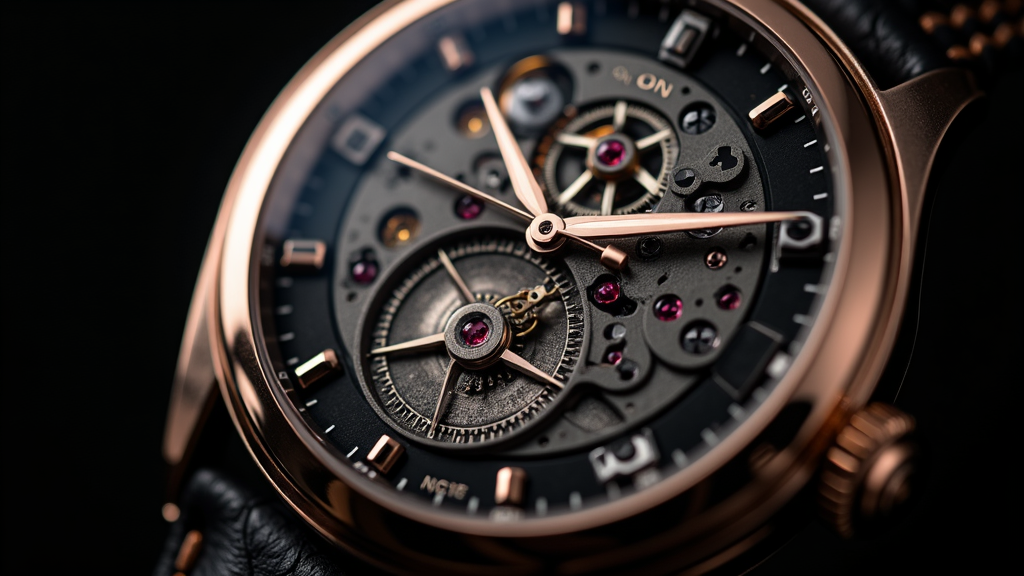
There is a small piece of metal spinning silently on the back of your mechanical watch right now, harvesting the motion of your wrist and converting a lazy afternoon of typing into stored energy. It never asks for attention. Most owners forget it exists. Yet without the automatic rotor, the modern self-winding watch — the object that lets millions of people ignore their crown for weeks at a time — would simply not work. It is one of horology's quietest revolutions, and one of its most misunderstood.
The Problem the Rotor Was Born to Solve
Every mechanical watch runs on a wound mainspring, a coiled ribbon of steel that slowly unwinds to drive the gears. For centuries, that spring was wound by hand. You turned the crown each morning, felt the tension build, and trusted the watch to run for a day or so before it wound down. Forget a morning, and your watch stopped.
Hand-winding is charming, but it has an obvious flaw: it depends entirely on human discipline. Watchmakers dreamed of a movement that wound itself using the one thing always available on the wrist — motion. The challenge was capturing that motion efficiently, in a package thin enough to live inside a watch case, without adding friction that would kill accuracy.
A Brief History of Winding Yourself
The idea is older than most people think. In 1777, Swiss watchmaker Abraham-Louis Perrelet built a pocket watch with an oscillating weight that wound the mainspring as the wearer walked. It was ingenious, but pocket watches sit still in a pocket, so the concept never fully caught on.
Harwood's Bumper
The wristwatch changed everything. Worn on a moving arm all day, it was the perfect host for self-winding. In 1923, English watchmaker John Harwood patented the first practical automatic wristwatch. His design used a weight that swung back and forth but could only rotate part-way before hitting spring-cushioned bumpers — earning it the nickname "bumper" or "hammer" automatic. You could actually feel the weight thudding gently against its stops.
Rolex and the Full Rotor
The breakthrough came in 1931, when Rolex introduced the "Perpetual" rotor: a semicircular weight that could spin a full 360 degrees in either direction. Freed from bumpers, it wound the mainspring far more efficiently and ran more smoothly. This full-rotor architecture became the template for virtually every automatic watch made since.
How It Actually Works
The mechanism is beautifully simple in principle. A weighted mass — the rotor — is mounted on a central pivot so it can swing freely. Because the weight is off-center (heavy on one side, light on the other), gravity keeps pulling the heavy edge downward. Every time your wrist moves, the rotor swings to find the lowest point, spinning around its pivot.
That rotational energy is transmitted through a train of reduction gears to the mainspring barrel. As the rotor turns, it slowly tightens the mainspring. A clever component called the reverser (or a set of pawls) ensures the spring winds regardless of which direction the rotor spins — clockwise or counter-clockwise, the energy always flows one way into the barrel.
The Slipping Clutch: Why It Doesn't Over-Wind
Here is the elegant part. What stops the rotor from winding the mainspring so tight it snaps? In a fully wound automatic, a "slipping bridle" at the outer end of the mainspring simply slips inside the barrel wall once maximum tension is reached. The rotor keeps spinning harmlessly, and the spring holds at full charge. This is why you cannot over-wind a properly functioning automatic watch, no matter how active you are.
Rotor Materials: Where Engineering Meets Beauty
The efficiency of the winding system depends heavily on the rotor's mass — a heavier weight captures more energy per swing. Early rotors were brass. But watchmakers soon realized that denser materials could deliver the same winding power in a thinner, more compact form.
Enter the exotic metals. Many high-end movements use rotors made of solid gold, prized both for its density and its luxurious appearance. Others turn to tungsten or platinum, some of the heaviest metals available, often skeletonized so the weight sits at the outer rim for maximum leverage. The result is a rotor that winds efficiently while showcasing serious material craftsmanship — the same obsession with substance you see across serious mechanical watchmaking.
Finishing matters here too. Because the rotor is often visible through a display caseback, it becomes a canvas: Côtes de Genève striping, perlage, engraved logos, and openworked designs turn a functional counterweight into a moving piece of art.
Micro-Rotors and Peripheral Rotors: Thinking Thinner
The Micro-Rotor
A traditional full rotor sits on top of the movement, adding thickness. To build thinner automatics, some watchmakers developed the micro-rotor — a much smaller weight recessed into the movement itself, sitting flush alongside the gears rather than above them. It winds a little less efficiently because it is smaller, but it allows for dramatically slimmer watches and leaves the movement architecture beautifully exposed.
The Peripheral Rotor
The most modern solution is the peripheral rotor: a thin ring of weighted metal that spins around the outer edge of the movement rather than across its face. It adds almost no thickness and — crucially — never blocks your view of the movement through the caseback. It is technically demanding to execute, which is exactly why independent and high-horology makers love it.
Automatic vs. Hand-Wound: Which Is "Better"?
Neither, really — they are different philosophies. Automatics offer convenience: wear the watch regularly and it stays running, no ritual required. Many also let you hand-wind the crown as a backup. Hand-wound movements, by contrast, are often thinner (no rotor taking up space), give an unobstructed view of the movement, and appeal to purists who enjoy the daily ritual of winding.
There is also the matter of the "phantom" cost. An automatic movement is mechanically more complex — the winding module adds parts, and those parts eventually need servicing. But for the vast majority of wearers, the freedom of never thinking about winding is worth every extra gear.
Caring for Your Automatic
If you rotate several watches, an automatic left unworn will simply stop and need resetting. Watch winders — motorized boxes that keep the rotor turning — solve this, though many collectors argue that constantly running a movement isn't necessary and simply reset when they pick a watch up. Either approach is fine. What matters is that, roughly every four to five years, the winding mechanism and its lubricants get the same professional servicing as the rest of the movement.
The Quiet Genius on Your Wrist
The automatic rotor is a masterclass in doing more with less: no battery, no electronics, just a cleverly balanced weight harvesting the incidental motion of a human body and turning it into stored time. Next time you take your watch off at night, flip it over and watch the rotor settle. That small, spinning half-moon is why your watch was still ticking when you woke up.
Featured Watch
Torq Mechanical Titanium
A precision mechanical movement housed in aerospace-grade titanium — engineering you can feel on the wrist, built around the same relentless pursuit of efficiency that gave us the self-winding rotor.
Explore Torq Mechanical Titanium →

Leave a comment
This site is protected by hCaptcha and the hCaptcha Privacy Policy and Terms of Service apply.