
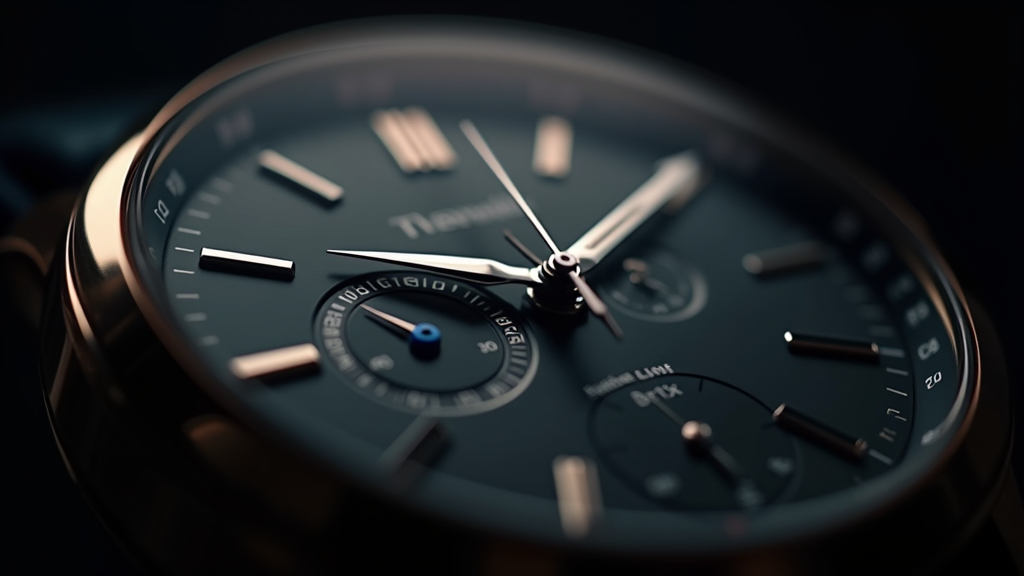

There is a delicious irony hiding inside one of watchmaking's most exclusive complications. For centuries, mechanical watchmakers have chased the ideal of a perfectly smooth, gliding seconds hand—the visual signature that separates a fine automatic from a battery-powered quartz. And then a small circle of master watchmakers spent enormous effort building a complication that makes a luxury mechanical watch tick like a cheap quartz movement, one crisp step per second. It is called the dead-beat seconds, and understanding why anyone would want it reveals something profound about how mechanical watches actually keep time.
What the Dead-Beat Seconds Actually Does
The dead-beat seconds—known in French as the seconde morte ("dead second") and sometimes as the true seconds or jumping seconds—is a complication that advances the seconds hand in one discrete, precise jump every full second. Instead of sweeping continuously around the dial, the hand pauses on each marker, snaps forward, and pauses again. The effect is hypnotic: a mechanical watch that appears to tick with the metronomic authority of an atomic clock.
To appreciate why this is strange, you need to understand the normal behavior. A conventional mechanical movement runs its escapement at a beat rate—commonly 28,800 vibrations per hour, or 8 beats per second. Each of those beats nudges the seconds hand forward a fraction of a millimeter. Because the human eye cannot resolve eight tiny jumps per second, the hand appears to sweep smoothly. That gliding motion is the accepted hallmark of mechanical horology.
The dead-beat seconds throws that away on purpose. It takes a movement that could sweep and forces its seconds hand to wait, then leap, exactly once per second—a single clean beat that lines up perfectly with the dial's markers.
Why Would Anyone Build This?
The answer begins, as so much of precision horology does, with astronomy and navigation. In the 18th and 19th centuries, scientific observatories and celestial navigators needed to read time to the exact second. A smoothly sweeping hand is surprisingly hard to read precisely—is it on the 23-second mark or just past it? A hand that snaps cleanly onto each marker eliminates the ambiguity. You can read the exact second at a glance and time an astronomical transit or a longitude sighting with confidence.
The complication was pioneered by names that still command reverence. Jean-Moïse Pouzait presented an early independent dead-beat seconds mechanism to the Geneva Society of Arts in 1776. Abraham-Louis Breguet—the man behind the tourbillon—refined the concept. For over a century, the dead-beat seconds was a tool of scientific precision, not a luxury flourish. Its revival in modern haute horlogerie is precisely because it is so counterintuitive: in an era where a $20 quartz watch ticks perfectly, building a mechanical watch that ticks is an act of magnificent, deliberate defiance.
How the Mechanism Works
There are two broad approaches to achieving dead-beat seconds, and the distinction matters enormously to collectors.
The Independent Dead-Beat (True Seconds)
In the most sophisticated version, the seconds hand is driven by its own dedicated gear train and its own escapement, or a secondary regulating system, separate from the main going train. A star wheel with precisely cut teeth is held back by a spring-loaded lever. Once per second, the lever releases, the star wheel rotates one tooth, the hand jumps, and the lever re-engages to hold it dead still until the next release. Because this system is decoupled from the main train, it does not steal energy or introduce error into the timekeeping itself.
The Constant-Force Cousin
Some dead-beat mechanisms are built around a remontoire—a constant-force device that stores and releases energy in fixed increments. Here the jumping seconds becomes a visible byproduct of a system designed to deliver perfectly even power to the escapement. The remontoire winds a tiny secondary spring, releases it once per second, and the seconds hand steps forward as it does. This is watchmaking at its most elegant: a single mechanism that both improves accuracy and produces a mesmerizing visual signature.
Building either version demands extraordinary precision. The jump must be instantaneous and identical every time, the hand must stop dead without the faintest quiver, and the energy budget of the entire movement must accommodate the extra work—all while keeping the watch slim enough to wear. It is the kind of challenge that separates independent ateliers from the rest of the industry.
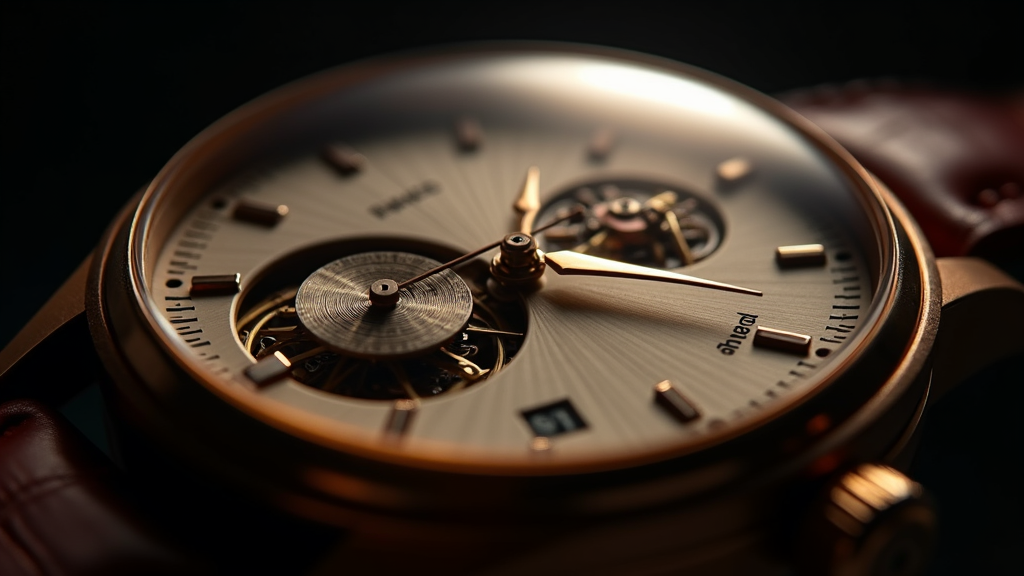
For collectors drawn to complications that reward close attention, the same philosophy of visible mechanical drama animates pieces like the Grandeur Center Tourbillon, where the movement's inner life is made part of the design rather than hidden beneath a solid dial.
Dead-Beat vs. Quartz: A Crucial Distinction
The most common misunderstanding is that a dead-beat mechanical watch is "just imitating quartz." The reality is the opposite. A quartz watch ticks once per second because that is the cheapest, most energy-efficient way to run a stepper motor—pulsing it once per second uses far less battery than continuous motion. The tick is a cost-saving compromise.
A mechanical dead-beat seconds achieves the same visual result through immense additional complexity, extra components, and extra energy expenditure. One is a shortcut; the other is a summit. The tell is in the crispness and the context: a dead-beat mechanical hand snaps with a precision and a confident dead-stop that betrays the hand-finished lever work beneath, and it lives on a dial surrounded by the other signatures of fine watchmaking.
The Modern Appeal
Why does the dead-beat seconds captivate collectors today? Partly it is rarity—few movements offer it, and fewer still do it well. Partly it is the intellectual pleasure of a complication that inverts expectations. But mostly it is the theater. A gliding seconds hand is beautiful in a quiet, continuous way. A dead-beat hand is eventful. Every second becomes a discrete little performance, a visible heartbeat you can count. In a world racing toward seamless digital everything, there is something deeply satisfying about a machine that marks time in confident, deliberate steps you can actually see.
The dead-beat seconds is horology arguing with itself—and, as usual, producing something wonderful in the process.
Featured Watch
Grandeur Center Tourbillon
Like the dead-beat seconds, the center tourbillon turns a feat of precision engineering into visible theater—mechanical drama placed front and center on the dial.
Explore Center Tourbillon →








Leave a comment
This site is protected by hCaptcha and the hCaptcha Privacy Policy and Terms of Service apply.