
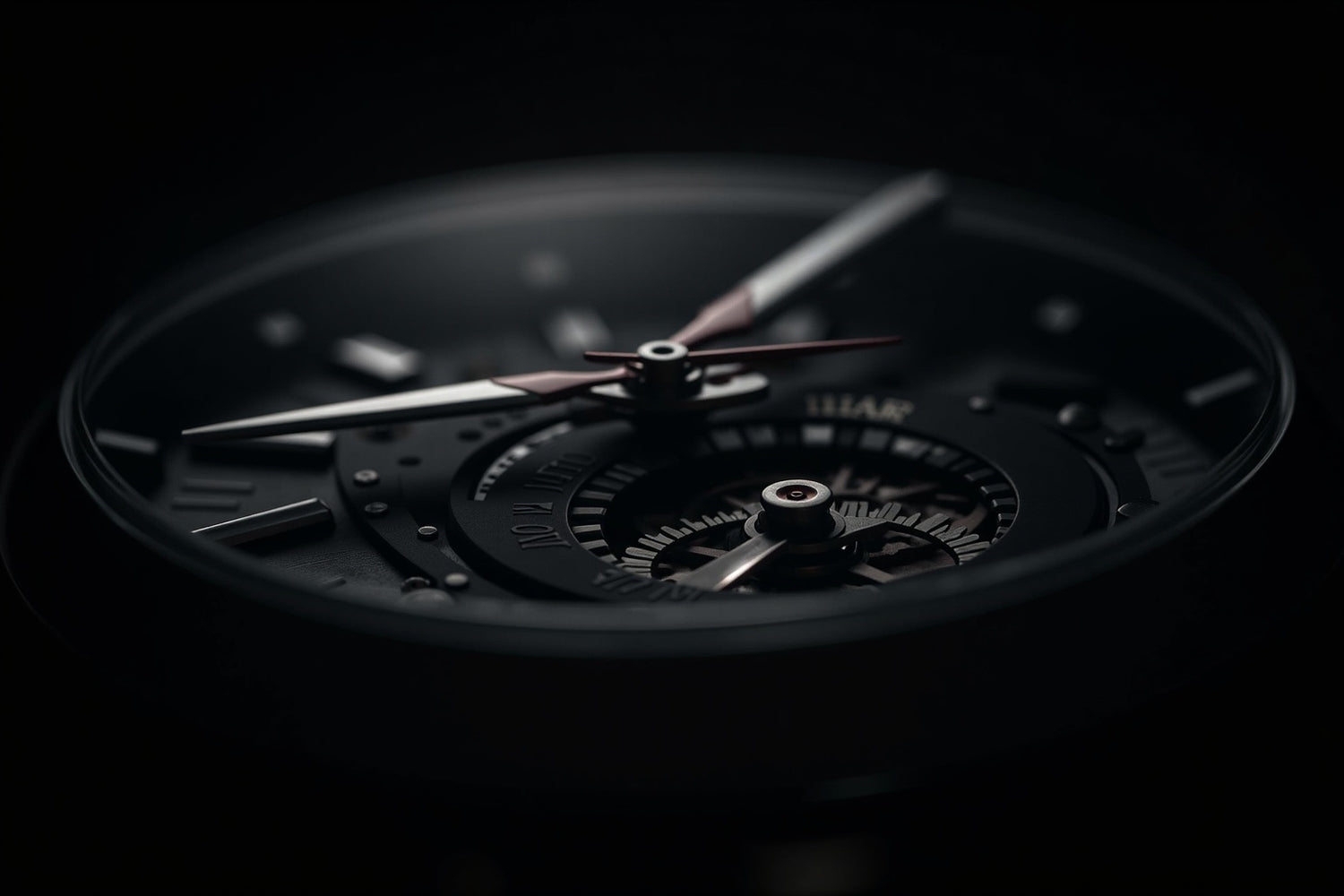
It's the closest thing watchmaking has to theater. A hand sweeps confidently across an arc, reaches its limit, and then — in a single, satisfying snap — flies back to zero to begin again. The retrograde display is mechanical drama compressed into a fraction of a second, and once you've watched it happen, an ordinary dial never quite looks the same.
What a Retrograde Actually Does
In a conventional watch, hands rotate continuously around a 360-degree dial. Twelve to twelve, sixty to zero, the hand simply keeps going in circles forever. A retrograde display breaks that loop. Instead of traveling a full circle, the hand sweeps along a curved arc — sometimes a quarter circle, sometimes a semicircle — and when it reaches the end of its scale, it instantly jumps back to the start.
That return trip is the magic. We call it the "fly-back," and on a well-made retrograde, it happens so fast the human eye can barely register the motion. One moment the hand is at the end of its journey; a blink later, it's home, ready to climb the arc again.
The most common version is the retrograde minutes, where minutes are displayed across an arc rather than a full circle. But watchmakers have built retrograde seconds, retrograde hours, retrograde dates, and even retrograde days of the week. There are perpetual calendars with four retrograde indicators, all flying back at different intervals — daily, weekly, monthly, and once a year.
The Mechanical Problem It Solves (and Creates)
A retrograde sounds simple until you try to build one. A normal hand is driven by a wheel that turns in one direction at constant speed. To make a hand climb an arc and then snap back, you need a completely different architecture.
The classic solution involves a snail cam — a spiral-shaped wheel that rises gradually from a low point to a high point over the course of an hour (for retrograde minutes). A spring-loaded lever rides the surface of this cam. As the snail rotates, the lever climbs higher and higher, and the lever drives the retrograde hand across the arc.
Then comes the cliff. At the top of the spiral, the snail's surface drops vertically back to its starting height. The lever, no longer supported, is pulled violently back to the bottom by its return spring. That spring-driven snap is the fly-back you see on the dial.
It's elegant. It's also brutal on the movement. Every hour, on the hour, energy is suddenly released across multiple components. If the cam, lever, and spring aren't perfectly tuned, you get one of three failures: the hand bounces past zero and rebounds, the spring overpowers the gear train and stops the watch momentarily, or — worst of all — components wear out far faster than they should. Building a retrograde that runs reliably for decades is genuinely hard. That's why the complication carries the prestige it does.
A Brief History of the Fly-Back
Retrograde mechanisms aren't new. They appear in pocket watches as early as the 18th century, often paired with calendar functions on tall-case clocks where space allowed dramatic indicators. Abraham-Louis Breguet, the great watchmaker of the Napoleonic era, used retrograde displays on several of his perpetual calendar pocket watches.
The complication went into a long quiet period during the 20th century, eclipsed by the chronograph and the moonphase. It came back into fashion in the 1990s and early 2000s, when independent watchmakers — looking for ways to differentiate from Swiss giants — rediscovered retrogrades as a way to build wristwatches that genuinely moved. Daniel Roth, Gérald Genta, and later F.P. Journe all leaned hard into retrograde architecture. Today, the complication is associated equally with traditional haute horlogerie and with contemporary independent design.
Why It Looks So Good on the Wrist
Most complications are intellectual. A perpetual calendar tracks leap years; a tourbillon counters gravity. They're impressive once you understand them, but they don't necessarily look like much from across a room. The retrograde is different. It's visual. Even someone who knows nothing about watchmaking will glance down, watch the minute hand fly back to zero, and ask: "Wait, what just happened?"
That theatrical quality is also why retrograde displays pair so well with asymmetric dials. Because the hand doesn't need a full 360 degrees of dial real estate, designers can place a retrograde scale wherever the composition calls for it — top arc, side wedge, sweeping diagonal — and balance it with off-center hours, jumping displays, or sub-seconds. The result is a dial that breaks symmetry on purpose, and feels alive because of it.
Retrograde Done Right: The Monocle
Grandeur's MONOCLE collection is built around exactly this principle. The minutes are presented as a sweeping retrograde arc across the upper half of the dial, paired with a jumping flap-hour display below. Once a minute, the minute hand snaps from sixty back to zero — a small, repeated piece of mechanical theater that the wearer gets to witness sixty times an hour.
The complication is paired with materials chosen to amplify the drama: meteorite on the Monocle Aureum, deep obsidian on the Monocle Noctis, and Azuris blue on the standard Monocle Azuris. The retrograde isn't a side dish on these watches — it's the whole point of the architecture.
What to Look For (and What to Avoid)
If you're considering a retrograde, three things separate the good from the merely decorative:
- Speed of the fly-back. A great retrograde snaps back in milliseconds. A poor one drifts back over a noticeable fraction of a second, which usually means the return spring is underpowered.
- Hand stability at full extension. Watch the hand at the very top of its arc, just before it returns. It should be rock-steady. Wobble or vibration there means the cam-and-lever interface isn't precise.
- No "stutter" at the start of a new cycle. After the fly-back, the hand should immediately begin its smooth climb. If it pauses or jumps a notch, the gearing isn't right.
Reliability matters too. Retrograde mechanisms put recurring stress on a small group of parts, and cheap ones will need service more often than a standard movement. If you're buying at a luxury price point, ask the brand directly about service intervals for the retrograde module specifically.
The Quiet Pleasure of Watching Time Reset
There's something almost philosophical about a retrograde. A normal watch suggests time is an unbroken circle — endless, indifferent, the same minute hand passing the same twelve again and again. A retrograde insists otherwise. It says: this hour is finished. We start fresh now. Sixty times an hour, the dial gives you a tiny ceremony of beginning again.
It's a small thing. But the best complications usually are.
Featured Watch
MONOCLE Collection
The MONOCLE is built around exactly the retrograde principle you just read about: a sweeping minute arc that snaps back to zero every sixty seconds. Three variants — Azuris, Noctis obsidian, and Aureum meteorite — each one a stage for the same mechanical theater.
Explore MONOCLE Collection →


Leave a comment
This site is protected by hCaptcha and the hCaptcha Privacy Policy and Terms of Service apply.