
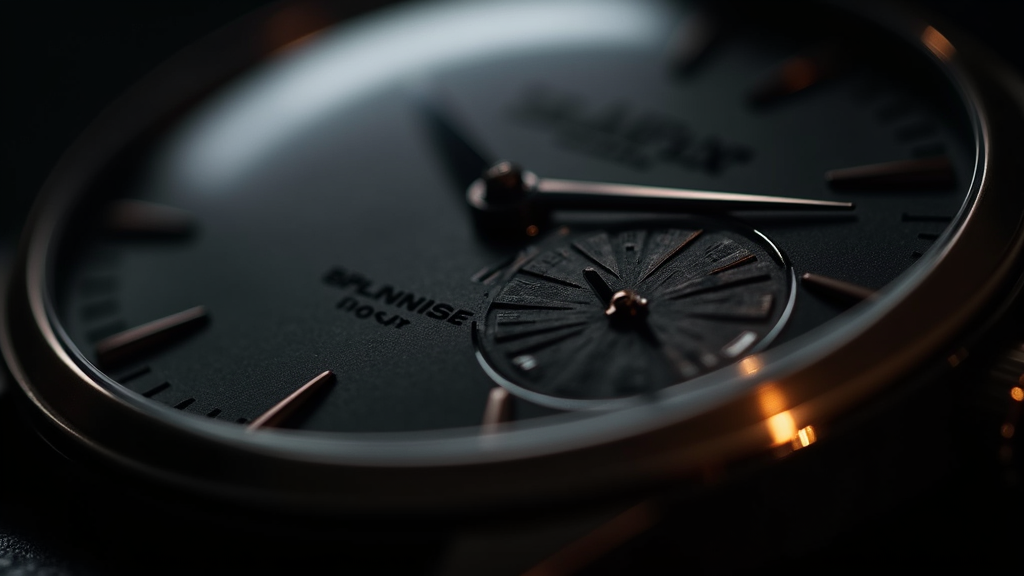
At exactly the top of the hour, something quietly radical happens inside a jumping hour watch. The minute hand sweeps past twelve, and instead of a graceful, analog transition — the kind that has defined watchmaking for four hundred years — the hour disc snaps. One numeral vanishes. Another materializes in its place. It is mechanical punctuation, a small act of defiance against the tyranny of the steady hand.
For a complication that most people have never heard of, the jumping hour has an extraordinary pedigree. It is one of the oldest alternative time displays in horology, a design philosophy that predates wristwatches themselves, and today it is enjoying a quiet renaissance among independent watchmakers who believe the face of a watch should do more than repeat the past.
A Complication Born in the 19th Century
The jumping hour — sometimes called heure sautante in French — was first patented in the late 1800s by Austrian watchmaker Josef Pallweber. In 1883, Pallweber filed a patent for a pocket watch mechanism that replaced traditional hands with rotating discs seen through windows cut into the dial. IWC licensed the design almost immediately, producing pocket watches marked with the Pallweber name that today are prized by collectors and routinely sold at auction for five figures.
At the time, it was nothing short of futuristic. The idea that you could glance at a watch and simply read the time, the way you read a book, felt almost mechanical telepathy. No estimating the minute hand's position. No squinting at tiny hash marks. Just numbers.
But the jumping hour was also ahead of its engineering. Early mechanisms struggled with energy management. Making a disc snap cleanly from one number to the next requires the movement to store tension for an entire hour and then release it, all at once, without stalling the rest of the gear train. It was a ticklish problem, and for most of the 20th century, jumping hours largely disappeared into obscurity.
How a Jumping Hour Actually Works
The magic lives in three tiny components: a star wheel, a tensioned spring, and a jumper.
Throughout the hour, the star wheel — typically with twelve points, one for each hour — rotates almost imperceptibly. As it turns, it progressively loads energy into a dedicated flat spring. The spring wants to release. The jumper, a tiny beak-like lever, holds the star wheel in place against a tooth. Everything is poised.
Then, at the fifty-ninth minute and fifty-ninth second, the minute cam reaches its peak. The jumper is forced to lift. For a fraction of a second, nothing is restraining the star wheel. The stored spring energy releases in a controlled snap, the wheel advances exactly 30 degrees, and the jumper drops into the next notch. A new hour appears in the window.
The whole event lasts perhaps a hundredth of a second. It is one of the few moments in a mechanical watch where motion is meant to be invisible — where the wearer sees only the result, not the act.
Why It's Harder Than It Looks
A conventional movement distributes its energy smoothly: the balance wheel sips power in tiny, rhythmic doses. A jumping hour, by contrast, demands a sudden, concentrated withdrawal from the mainspring every sixty minutes. If the spring is too weak, the disc hesitates and the numeral appears mid-rotation — an embarrassing crime against the complication's entire purpose. If it's too strong, the disc overshoots and bounces back, causing alignment issues. And if the load is poorly isolated, the rest of the movement loses amplitude at the moment of the jump, sometimes enough to affect timekeeping.
This is why true jumping hour watches — the ones where the numeral snaps crisply, instantly, at exactly the top of the hour — remain relatively rare. Getting it to work reliably is one thing. Getting it to feel right is another entirely.
The Modern Jumping Hour Renaissance
The complication came roaring back into contemporary horology in the 1990s and 2000s, championed by a handful of independents who saw its potential for design. Daniel Roth, Gerald Genta, and later houses like Vianney Halter and F.P. Journe turned the jumping hour into a canvas for creative dial architecture. When there are no hands cluttering the dial, suddenly the whole face becomes real estate for invention.
This is the part of the story that matters most for enthusiasts today: the jumping hour isn't really about telling time differently. It's about displaying time differently. Once you remove the hour hand, you free the designer to reimagine the entire composition — asymmetrical layouts, off-center minute tracks, retrograde seconds, and apertures that can appear anywhere on the dial. The complication is a license to break the grid.
Why Collectors Keep Coming Back
For serious collectors, the jumping hour occupies a sweet spot. It is technically demanding enough to prove a watchmaker's chops, visually distinctive enough to stand out in a collection dominated by three-hand sports watches, and — crucially — still relatively affordable compared to complications like tourbillons or minute repeaters. A well-executed jumping hour from an independent maker sits at an intersection of mechanical credibility, design courage, and rarity that few other complications can match.
It is also, quietly, one of the most satisfying complications to live with. A tourbillon is beautiful but you can forget it's there. A jumping hour announces itself, sixty times a day, every day. It's a small, reliable piece of theater on your wrist.
A Living Example
At Grandeur, the jumping hour runs through much of our design language precisely because it invites architectural freedom. The 18k Gold Strange Edition uses a patented jumping hour module conceived with a Salvador Dali–inspired case to make the display feel almost surreal — time appearing and disappearing through a window framed in solid gold. In the Monocle Azuris, the jumping hour is paired with retrograde minutes to create a display that resets and renews itself with equal drama every sixty minutes. Different expressions, same underlying rebellion: time as event, not as arrow.
The Takeaway
The jumping hour is a reminder that horology is not a solved problem. Every mechanical watch is a set of choices about how to represent something — time — that has no natural visual form. The analog hand is one answer, and it is a beautiful one. But it is not the only answer, and it was never meant to be.
Every hour, somewhere on someone's wrist, a tiny disc snaps forward and a new numeral appears. It is a small gesture, but it carries two centuries of mechanical ambition behind it. In a world saturated with screens that can display anything in any way, there is something deeply satisfying about a mechanism that chose, in 1883, to do things differently — and still hasn't backed down.
Featured Watch
MONOCLE AZURIS — Jump Flap Hour
The MONOCLE takes the jumping hour concept further than anyone: a world-first jump flap display that physically flips the hour indicator. Paired with retrograde minutes, it creates two layers of mechanical theater on a single dial.
Explore MONOCLE AZURIS — Jump Flap Hour →

Leave a comment
This site is protected by hCaptcha and the hCaptcha Privacy Policy and Terms of Service apply.