
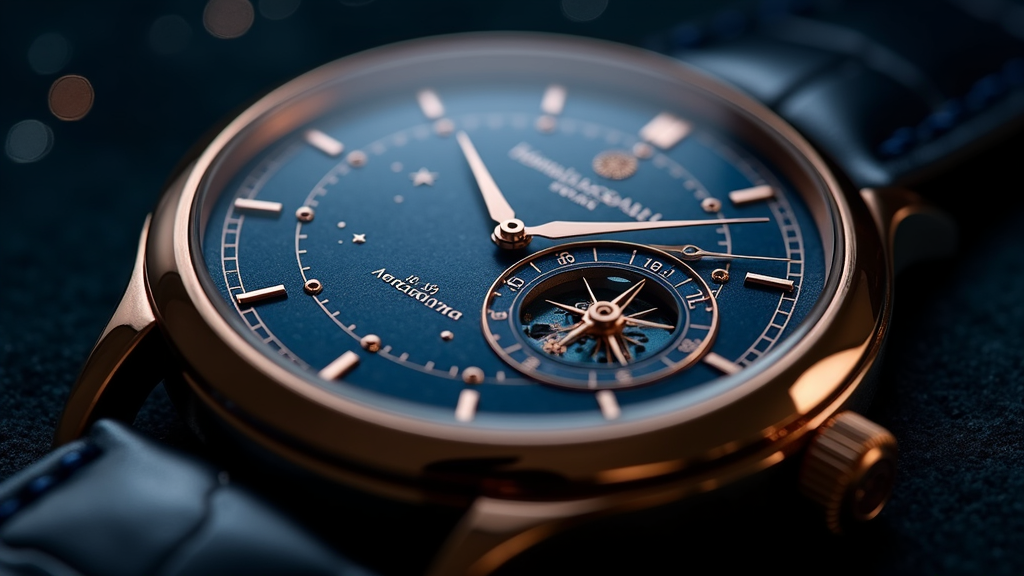

Here is a fact that quietly undoes everything you thought you knew about time: the sun is almost never on time. The watch on your wrist, the clock on your wall, the atomic standard humming in Boulder — they all tell mean time, a tidy fiction we invented to make the day exactly 24 hours long. The actual sun, the one that crosses the meridian and casts your shadow, runs ahead by as much as 16 minutes in November and lags by 14 minutes in February. The difference between those two times — clock and sky — is called the equation of time, and reproducing it mechanically is one of the most quietly beautiful achievements in all of horology.
Why the Sun Refuses to Cooperate
For thousands of years, humans measured time by the sun. A sundial was the standard; civic clocks were corrected by it. But two facts of celestial mechanics conspire against the sun being a reliable timekeeper.
The first is that the Earth's orbit around the sun is not a perfect circle. It is an ellipse. We travel faster when we are closer to the sun (around January) and slower when we are farther (around July). This means the sun appears to drift across our sky at slightly different rates throughout the year.
The second is that the Earth's axis is tilted by about 23.4 degrees. Even if the orbit were perfectly circular, that tilt alone would cause the apparent solar day to vary in length, because the sun's motion is projected onto a celestial equator that is not aligned with the ecliptic.
Add these two effects together and you get a curve — a tilted figure-eight when plotted on a graph of declination versus the equation of time — known as the analemma. It is the same figure-eight you would see if you photographed the sun from the same spot at the same clock-time every day for a year. The sun would trace a lopsided 8 in the sky. We did not invent this. We simply learned to read it.
The Birth of Mean Time
For most of human history, the sun's irregularity did not matter. You ate when you were hungry. You slept when it was dark. Local solar noon was good enough.
That changed with two inventions: the pendulum clock in 1656, and the railway in the 1800s. The pendulum clock was so accurate that it began to disagree with sundials — and people could see it. Public clocks in 17th-century Europe sometimes had tables engraved beside them telling viewers how much to add or subtract to get "true" sun time. Astronomers compiled these tables annually.
By the time the railroads forced the standardization of mean time — and eventually, in 1884, time zones — the sun had been quietly demoted. The clock now told the truth; the sky was the variation. The equation of time became a curiosity, a relic of an older relationship between humans and the heavens.
Putting the Analemma on a Wrist
Mechanical watchmakers, of course, could not resist. If the sun varied in a predictable annual cycle, the cycle could be reproduced by a cam — a precisely shaped piece of steel whose profile traces the equation of time as it rotates once per year.
This is the heart of every mechanical equation-of-time complication ever built: a small kidney-shaped or figure-eight-shaped cam, driven by the annual calendar wheel, rotating once every 365.25 days. A feeler — usually a tiny ruby-tipped lever — rides the cam's edge. As the cam profile rises and falls, the feeler pivots, and that pivot drives a small indicator hand or sector on the dial.
The result is a hand that points to "+15 minutes" in late October and "−14 minutes" in mid-February, telling the wearer exactly how much their wristwatch disagrees with the actual sun overhead. It is, in essence, a mechanical translation of a celestial fact.
Two Schools of Display
Watchmakers have settled on two main ways of showing the equation of time:
The indirect display. The dial shows a small sector — typically marked from −15 to +15 minutes — with a single hand pointing to the current value. The wearer adds or subtracts that number from the displayed time to find apparent solar time. This is by far the more common arrangement, used by Audemars Piguet, Blancpain, Jaeger-LeCoultre, and most of the historic English makers.
The running equation. Far rarer and far more impressive. The watch carries two minute hands — one for mean time, one for solar time — that drift slowly apart and back together over the course of a year. No mental math required. You simply read solar time directly. Breguet, Panerai, and a handful of independents have produced running-equation pieces. Each one is essentially a horological flex, because it requires duplicating part of the going train.
The Cam Is Where the Art Lives
The deceptively simple cam at the center of this complication is one of the most demanding components in a watch movement. Its profile must trace the equation of time to within a fraction of a minute across all 365 days. Master watchmakers shape these cams by hand to tolerances measured in microns, then polish them so the feeler glides without friction or wear.
A poorly cut cam will be off by minutes in spring and accurate in fall. A great one will be accurate everywhere — and will continue to be accurate a hundred years from now, because the underlying astronomy does not change on human timescales. Within the world of independent watchmaking, the willingness to spend two weeks hand-finishing a single cam is precisely the kind of detail that separates a watch from a luxury object.
Why Build It at All?
Here is the honest part. Nobody needs an equation-of-time watch. You will never plant crops by it. You will never set sail by it. The age of sundial-based navigation ended before electricity.
And yet. There is something quietly profound about wearing a mechanism that admits the clock is the fiction and the sky is the truth. Every other complication on a watch — chronograph, perpetual calendar, repeater — is engineered to make our human systems more precise. The equation of time alone exists to remind us that the universe never agreed to our 24-hour day in the first place. We squeezed time into a box. The sun does not care.
That is why collectors love it. An equation-of-time complication is the rare horological feature that is fundamentally humble. It does not measure something better than the sky — it reconciles itself to the sky. It is a small mechanical confession that, for all our standardization and atomic clocks and time zones, the day we live on is still set by an enormous fusion reactor 93 million miles away, and that reactor was never going to be on time.
The Future of an Ancient Idea
You might assume the equation-of-time complication is on its way out — a relic in an era of GPS-corrected smartwatches. The opposite is happening. Over the last decade, independent makers have produced more equation-of-time pieces than at any point in the 20th century. Krayon's Everywhere, MB&F's collaborations with Stepan Sarpaneva, modern Breguet references, recent A. Lange & Söhne calendars — the complication is having a quiet renaissance.
Why? Because in a world of digital precision, the most luxurious thing a watch can do is point at something honest. A complication that tracks the actual sun is, in 2026, more meaningful than one that beats faster or carries a tourbillon. It says: I know the world is messier than we pretend, and I am willing to wear that on my wrist.
The next time you check your watch at noon and notice the sun is not yet at its peak — or has already passed — remember that your watch is wrong, by design. And somewhere out there, a small kidney-shaped cam is quietly rotating, ready to tell you exactly how wrong, and why.
Featured Watch
Center Tourbillon
When watchmaking decides to humble itself before the cosmos — whether through a tourbillon's whirling cage or an equation-of-time cam — what emerges is mechanical poetry. Our Center Tourbillon embodies that same reverence for celestial mechanics.
Explore Center Tourbillon →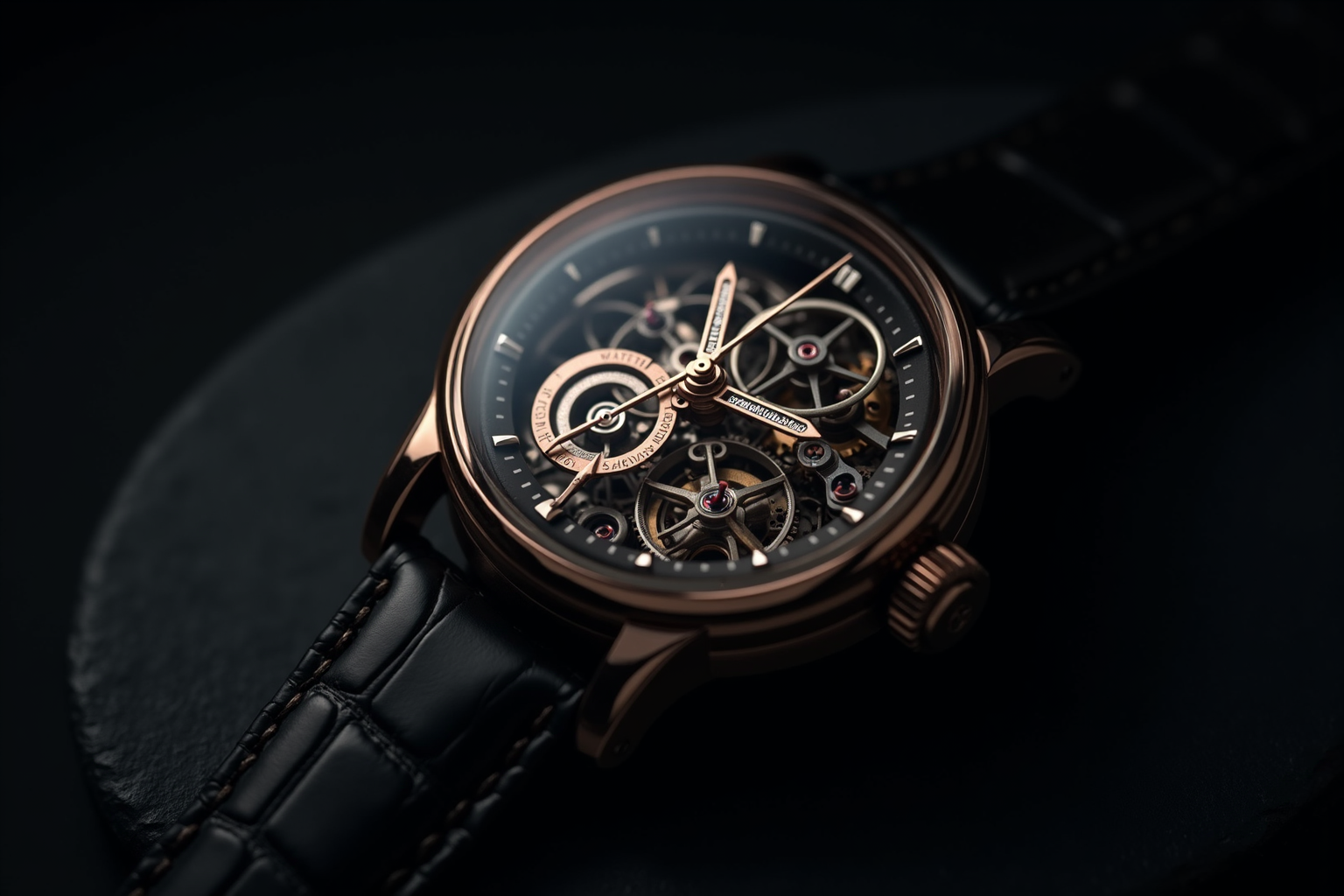







Leave a comment
This site is protected by hCaptcha and the hCaptcha Privacy Policy and Terms of Service apply.