
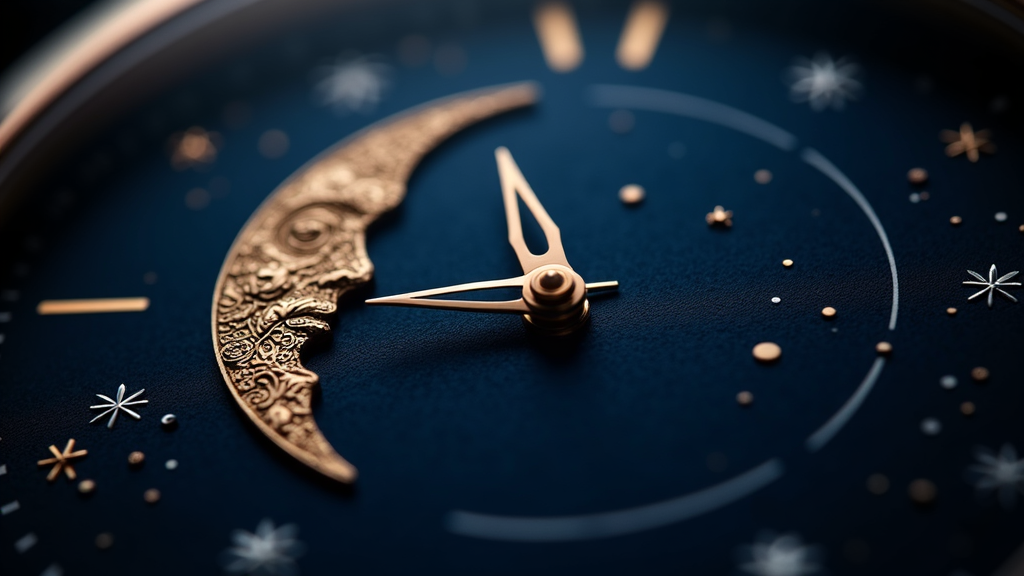
Of all the complications a mechanical watch can carry, the moon phase is the most romantic. It serves no urgent purpose. It does not help you board a flight, time a lap, or remember your anniversary. It simply tracks the waxing and waning of a celestial body 238,855 miles away — and it has been doing so, on European wrists and in European pockets, for over four hundred years.
That's the strange power of horology. The most useful complications are rarely the most beloved. The moon phase is a meditation in metal: a quiet acknowledgment that we measure our days not just in hours and seconds, but in tides, in seasons, in lunar months older than any clock.
What a Moon Phase Complication Actually Does
At its simplest, a moon phase complication shows the current phase of the moon — new, waxing crescent, first quarter, waxing gibbous, full, waning gibbous, last quarter, waning crescent — through a small aperture on the dial. Behind that aperture sits a disc, usually painted or engraved with two moons, that rotates slowly beneath a fixed cutout shaped to reveal exactly the right portion of the moon at any given time.
The mechanism is driven by a 59-toothed wheel. Why 59? Because a synodic month — the time from one new moon to the next — is approximately 29.53 days. Two lunar cycles equal roughly 59 days, so a 59-tooth wheel advanced by one tooth per day completes one revolution every two months, displaying both moons in sequence.
The Accuracy Problem
Here is where it gets interesting for collectors. The 59-tooth standard moon phase is approximately right. The actual synodic month is 29.5305882 days. Round to 29.5 days, and your watch's moon falls behind reality by one full day every 2 years and 7.5 months.
For most owners, this is fine — you reset the moon when daylight savings rolls around and forget about it. But for purists, an entire branch of haute horlogerie exists to fix this rounding error. The astronomical moon phase uses a 135-tooth wheel and a more elaborate gear train to achieve accuracy of one day deviation every 122.6 years. Some modern movements, like Andreas Strehler's "Lune Exacte," push this to a deviation of one day every 14,000+ years — a precision so absurd it borders on the philosophical.
A Brief History of the Moon on the Wrist
Moon phase indicators predate the wristwatch by centuries. They appear on astronomical clocks of the 14th and 15th centuries, including the famous Prague Astronomical Clock (1410), which still tracks lunar phases today. Pocket watches with moon phases became fashionable in the 17th century, often paired with calendar functions to help wearers track religious feasts and agricultural cycles.
The complication migrated to the wrist in the early 20th century, but its true golden age followed a near-extinction event. During the Quartz Crisis of the 1970s and 1980s, mechanical complications collapsed in commercial relevance. The moon phase, considered decorative and obsolete, nearly disappeared.
Then, in the late 1980s, mechanical watchmaking staged its renaissance. Brands rediscovered romance. Patek Philippe's perpetual calendars, IWC's Portugieser, and Blancpain's Villeret collection put the moon back on the dial — and it has remained there ever since, a quiet symbol of mechanical poetry surviving the digital age.
How the Moon Disc Is Made
The aesthetic execution of a moon phase often matters more than its mechanism. Traditionally, the disc is brass, plated in blue or black, with two golden moons stamped or laser-engraved into its surface. The stars surrounding the moons are sometimes simply printed; on higher-end pieces, they are individually applied or formed by a sand-blasted texture.
The most beautiful executions use aventurine glass — a deep blue, glass-based material studded with copper-colored flecks that catch light like a real night sky. Cutting and polishing aventurine into a disc thin enough to rotate without scraping the dial is genuinely difficult. The material is brittle, and a moon phase disc is typically less than a millimeter thick.
Other artisanal approaches include grand feu enamel moons (kiln-fired at 800°C for impossible depth of color), hand-engraved gold appliques, and meteorite discs cut from actual fallen iron meteorites. Each technique transforms a tiny mechanical part into a miniature work of art.
The Eyes Have It
One of horology's quiet jokes: many moon phase moons have faces. Look closely at watches from Patek Philippe, Jaeger-LeCoultre, A. Lange & Söhne, and most independent makers, and you'll see a serene, slightly smiling face engraved or printed onto the lunar disc. There is no mechanical reason for it. The face is purely decorative — a tradition borrowed from medieval astronomical clocks, when the moon was personified as a god, a friend, a witness to time itself.
Some modern brands have abandoned the face for stark astronomical accuracy. We respect the choice. But there is something deeply human about a moon that smiles back.
The Moon Phase as Design Element
For watchmakers, the moon phase aperture creates a design challenge: where do you put it? Place it at 6 o'clock and you have the classic "smiley face" layout — symmetrical, balanced, traditional. Tuck it into a sub-dial and it becomes part of a complicated calendar display. Fill the entire dial with a rotating moon and you have something extraordinary, like the dome-shaped lunar displays of certain modern complications.
The moon phase pairs especially well with stone dials. There is a poetic continuity between celestial bodies and the minerals formed in the crucible of stars — meteorite, aventurine, lapis lazuli, malachite. A moon phase aperture cut into a piece of polished obsidian has the gravity of an actual sky.
Featured Watch
Grandeur Strange V3 Stone Dials
If the moon phase belongs anywhere, it belongs above stone — minerals born of the same cosmic furnace as the moon itself. The Strange V3 brings that celestial gravity to the wrist.
Explore Strange V3 Stone Dials →Setting and Caring for a Moon Phase
A few practical notes for owners. Most moon phase complications are adjusted via a recessed pusher on the case side, requiring a thin tool (often included with the watch). To set it accurately, find the date of the most recent new moon, then advance the moon phase one click for each subsequent day.
Crucial rule: never adjust the moon phase between 9 PM and 3 AM. During this window, the date and calendar gears are engaged and partially advanced. Forcing the moon phase pusher in this state can shear teeth from delicate wheels — an expensive lesson many owners learn exactly once.
If your watch stops or you neglect to wind it for a few days, the moon phase will drift out of sync with reality. This is normal. A simple reset to the current lunar phase brings it back into alignment. Some collectors find this small ritual one of the genuine pleasures of ownership: a few times a year, you look up at the actual moon, then back at your wrist, and synchronize the two.
Why It Endures
The moon phase is, in pure utility terms, the least necessary complication a mechanical watch can carry. We have phones. We have apps. We have NASA telling us, to the second, what phase the moon is in over any city on Earth.
And yet — every serious watchmaker still makes moon phases. Every collector still wants one, eventually. There's a reason. A moon phase on the wrist is a small, persistent reminder that time is older than us. Older than clocks. Older than civilization. The same moon that pulls oceans across continents is reproduced, in miniature, on a brass disc the size of a fingernail, advancing one tooth a day, marking a cosmic rhythm we did not invent and cannot stop.
That's not a complication. That's a small wearable monument to the sky.







Leave a comment
This site is protected by hCaptcha and the hCaptcha Privacy Policy and Terms of Service apply.