
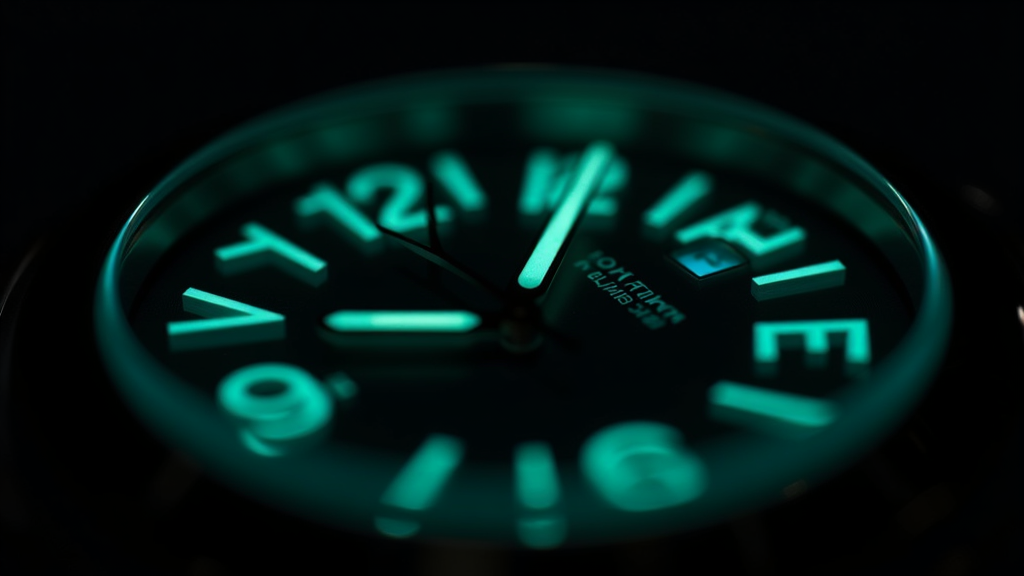
A century ago, asking a watch for the time after sundown meant striking a match. Today, your dial glows for hours without a single photon of help from your nightstand. The journey from radium to Super-LumiNova is one of horology's strangest stories — a tale of beauty, science, and tragedy.
Before the Glow: Reading Time in the Dark
For most of horological history, telling time after sunset was a problem you solved with fire. Pocket watches had repeater complications that chimed the hour and minute on demand — elegant, but mechanically extravagant. The arrival of the wristwatch in the early 20th century, especially in military contexts, demanded something simpler: a dial you could read in a trench, a cockpit, or a submarine. The answer turned out to be radioactive.
The Radium Era (1908–1960s)
In 1908, the U.S. Radium Corporation introduced a paint called "Undark." Its recipe was deceptively simple: zinc sulfide as the phosphor, mixed with a tiny amount of radium-226. The radium emitted alpha particles that bombarded the zinc sulfide crystals, exciting them into a continuous, ghostly green glow. Unlike modern lume, radium paint never needed charging — it would glow for the entire half-life of the radium, roughly 1,600 years.
For watchmakers, it was magical. For the women hired to paint dials in factories from New Jersey to Switzerland — the "Radium Girls" — it was catastrophic. Workers were instructed to lick their brushes to a fine point between strokes, ingesting tiny doses of radium with every dial. The resulting bone cancers, jaw necrosis, and the landmark lawsuits that followed reshaped American occupational safety law in the 1920s and 30s.
How to Spot Radium Today
Vintage watches from the 1930s through the early 1960s — especially military issue pieces, early Rolex sport models, and Omega Seamasters — often still contain radium paint. The glow has long since faded (because the zinc sulfide phosphor degrades, not the radium), but the radiation has not. Collectors handle these pieces carefully, store them outside bedrooms, and never, ever attempt to scrape or repaint them.
Tritium: The Quieter Cousin (1960s–1990s)
By the late 1960s, the watch industry had a problem. Radium was a public-relations disaster, but glowing dials had become an expectation. The solution was tritium — hydrogen-3, a low-energy beta-emitter with a half-life of just 12.3 years.
Tritium-painted dials carried the famous "T SWISS MADE T" or "T < 25" markings at the six o'clock position, indicating that tritium was used and that the total radiation dose remained below regulatory thresholds. The glow was dimmer than radium and faded over time as the tritium decayed, but it was vastly safer to handle.
This is why so many 1970s and 80s sports watches now have soft cream or pumpkin-colored hour markers: the tritium phosphor has degraded into a patina that collectors actively prize. A perfectly aged "tropical" tritium dial can add thousands to a vintage Submariner's value.
Tritium Gas Tubes
A second tritium technology emerged in parallel: small borosilicate glass tubes filled with tritium gas, internally coated with a phosphor. These tubes glow for 20–25 years without any external light source and remain popular today in tool watches from brands like Ball and Marathon. The tritium is sealed inside the tube — if it breaks, the gas dissipates harmlessly into the atmosphere. Different gas mixtures produce different colors: green, blue, orange, yellow, even pink.
The Non-Radioactive Revolution: Super-LumiNova (1993–Today)
In 1993, the Japanese chemical company Nemoto & Co. patented a compound called LumiNova. The Swiss firm RC Tritec licensed it and rebranded a refined version as Super-LumiNova in 1998 — and the watch industry never looked back.
Super-LumiNova is built on strontium aluminate doped with europium and dysprosium. It's a photoluminescent compound, meaning it absorbs photons of visible or UV light, stores that energy in the crystal lattice, and slowly releases it as a green or blue afterglow. It's not radioactive, not toxic, and — critically — can be charged again and again, forever, without degrading.
A well-applied layer of Super-LumiNova, fully charged under bright light, can produce a readable glow for 8 to 12 hours. The brightest grades (currently the "X1" series) start out so intense they're nearly painful to look at in the dark.
Why It Glows Green (Mostly)
Strontium aluminate's natural emission falls in the 500–530 nanometer range — the green-yellow part of the spectrum the human eye is most sensitive to in low-light conditions. This isn't an aesthetic choice; it's evolution. Our scotopic (night) vision peaks at almost exactly this wavelength. Watchmakers who use blue lume sacrifice some legibility for the cooler color tone.
Today's lume comes in a remarkable spectrum: vanilla cream, aged "fauxtina" amber, ice blue, mint, even pink. The phosphor chemistry is the same; the visible daylight color is just a tinted carrier mixed into the paint.
The Application: A Painter's Craft, Still
Despite the futuristic chemistry, applying lume in 2026 looks remarkably like it did in 1926 — minus the radioactivity. A dial maker mixes Super-LumiNova powder with a binder (often a lacquer or epoxy) to create a paste with the consistency of toothpaste. That paste is then applied by hand, dot by dot, into the recessed hour markers or onto the hands using a fine brush or a tiny syringe.
The artistry is in the dome. A perfectly applied lume plot is slightly raised and convex, like a tiny droplet frozen at the moment of impact. Get it too flat and the watch looks cheap. Get it too tall and it cracks during curing. Watch how light catches the markers of a well-finished dial — that subtle highlight on each lume dot is several minutes of work by a steady-handed dial maker, multiplied by twelve.
For an example of lume done as a design language rather than a checkbox, see how the Grandeur Center Tourbillon uses fully luminescent indices and hands to transform from formal mechanical jewelry by day into a glowing piece of horological architecture at night.
The Future of Glow
Research labs are working on the next generation. Long-afterglow phosphors based on rare-earth elements like terbium and samarium are pushing visible glow times past 24 hours. Photoluminescent fully-printed dials — where the entire dial surface, not just the indices, emits light — have appeared on a handful of independent pieces. Some experimental movements use lume-treated jewels and pinions, so even the gear train glows faintly through the open caseback.
And the old technologies haven't entirely disappeared. Tritium tubes remain a serious tool-watch standard precisely because they don't need charging. A submariner working a 14-hour shift in zero light still benefits from radioactive decay in ways that strontium aluminate cannot replicate.
Why It Still Matters
Lume is, on the surface, a feature so minor it barely warrants a complication list line. You can buy a quartz watch with a backlit LCD for $40 and forget the entire problem. But the glow of a mechanical dial in a dark bedroom is a small piece of magic — the slow, patient release of stored photons, no battery, no electronics, just chemistry doing its quiet work for the next several hours.
That's the soul of horology in miniature: making something better than it strictly needs to be, in ways most people will never see, simply because it deserves to be made well.
Featured Watch
Grandeur Center Tourbillon
A flying tourbillon framed by fully luminescent indices and hands — engineered to be a mechanical sculpture by day, and a glowing piece of architecture once the lights go out.
Explore Center Tourbillon →

Leave a comment
This site is protected by hCaptcha and the hCaptcha Privacy Policy and Terms of Service apply.