
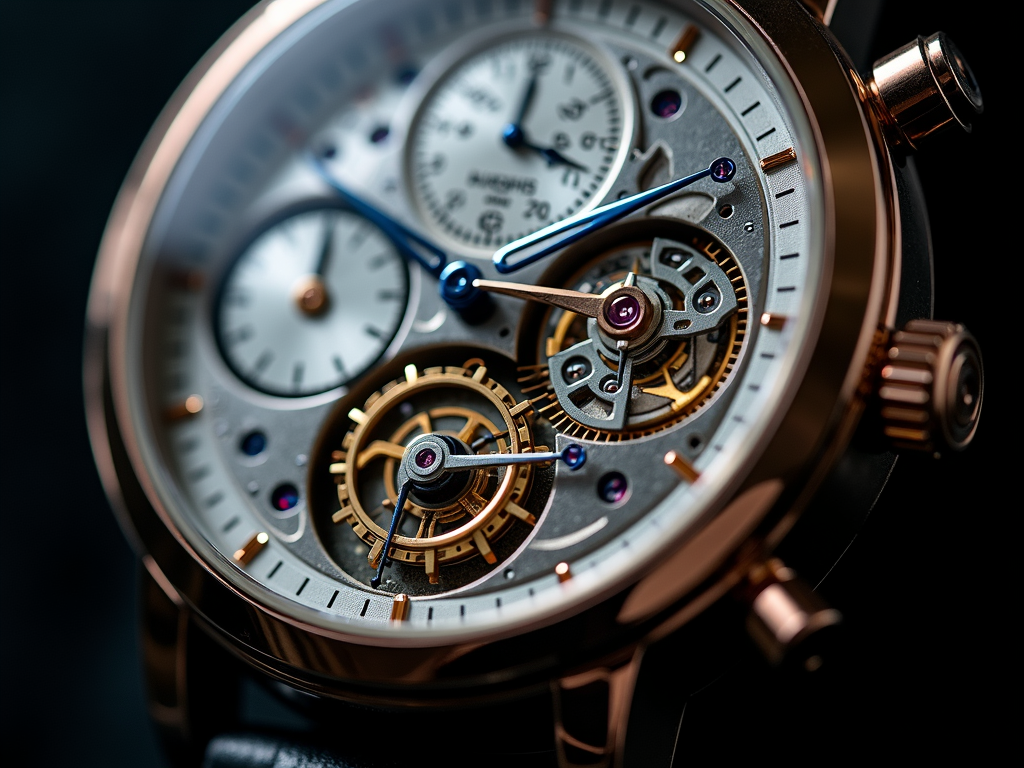
Wind it today, set the date once, and hand it to your grandchildren in 2124 — the calendar will still be right.
Of all the complications in horology, none is quite as quietly audacious as the perpetual calendar. Tourbillons spin for the cameras. Minute repeaters sing for applause. But a perpetual calendar just sits there, keeping track of every irregular month and every leap year without asking for anything, for as long as you keep it wound. It's a mechanical computer built from gears and levers in the 1700s — and it still works.
The Problem With Calendars
Here's the annoying thing about our calendar: it's a mess. Twelve months, but not all of them are the same length. Thirty days hath September, April, June, and November — the rest have 31, except February, which has 28, or 29 if it's a leap year. And leap years come every four years, except on centuries, except on centuries divisible by 400. The year 2000 was a leap year. The year 1900 wasn't. The year 2100 won't be.
Most mechanical watches — even expensive ones — don't deal with any of this. A standard date complication just assumes every month has 31 days, so you have to manually correct it five times a year: after February, April, June, September, and November. A perpetual calendar handles all of it automatically. You set it once, and it stays right until the year 2100.
Why 2100?
That's the century-leap-year exception. Since 2100 isn't divisible by 400, it won't be a leap year — and traditional perpetual calendars are programmed to add a February 29th that year anyway. Owners will need to bring them in for a one-day correction. A small handful of ultra-high-end watches, sometimes called secular perpetual calendars, account for this rule too. Those are accurate until the year 4000, at which point someone else's problem.
How It Works: A Mechanical Computer in Miniature
The heart of a perpetual calendar is a component called the grand levier, or the Big Lever, paired with a set of specially-shaped cams. Think of it as an analog memory chip.
The most critical piece is the 48-month cam — a rotating wheel with a notched edge carved to represent four full years (48 months, including one leap February). The notches vary in depth: deeper notches for 30-day months, shallower for 31, and a very deep notch for February. An even deeper notch corresponds to the leap-year February.
Every night, as the watch ticks toward midnight, a system of levers and springs reads this cam's surface like a needle on a vinyl record. Depending on how deep the notch is, the date mechanism jumps forward by a different amount:
- From a 31-day month, the date rolls 31 → 1 (one jump)
- From a 30-day month, the date jumps 30 → 1 (skipping 31)
- From a 28-day February, it jumps 28 → 1 (skipping 29, 30, 31)
- From a leap-year February, it jumps 29 → 1
All of this happens through the physical interaction of springs, cams, and levers roughly the size of a grain of rice. There is no electronics, no sensor, no microchip. Just geometry and patience.
A Brief History
The first perpetual calendar watch was built by Thomas Mudge in London around 1762 — a pocket watch now housed at the British Museum. Mudge was also the inventor of the lever escapement, which means he essentially invented two of the most important things in modern watchmaking in a single career. Overshadowed? Mudge was.
The complication remained exceptionally rare for the next 160 years. Patek Philippe produced the first wristwatch with a perpetual calendar in 1925, converting a ladies' pendant movement into a gentleman's wristwatch. It was a one-off. Serial production didn't begin until the Patek Philippe 1526 in 1941 — of which fewer than 210 were ever made.
The Survival Story
By the 1970s, the quartz crisis had nearly wiped out high-end mechanical watchmaking. The perpetual calendar came very close to extinction. It was Audemars Piguet, in 1978, that saved it — releasing the ultra-thin caliber 2120/2800, an automatic perpetual calendar just 3.95mm thick. The watch was beautiful, it was mechanical in a world going digital, and it sold. Within a few years, Patek, Vacheron, IWC, and Blancpain had all revived their perpetual calendar programs. The complication survived the century.
Why It Still Matters
In a world where your phone shows the date perfectly and your smartwatch syncs atomic time from satellites, why would anyone care about a mechanical calendar that can drift a day by 2100?
Because that's not the point. A perpetual calendar is a statement about the possible. It's three hundred tiny parts doing something that sounds computational — tracking the irregularities of the Gregorian calendar — using nothing but the physical laws of levers and springs. It's proof that brains and patience can substitute for processors. And it's one of the few objects you can own today that will still be doing its job, unchanged, in a hundred years.
There's also something deeply personal about it. A perpetual calendar is not set up for you at the factory — it's calibrated for a specific moment. When a watchmaker hands you one, they're essentially saying: "Here is time, starting now. Don't stop it."
What to Look For
If you're shopping for a perpetual calendar — or just admiring from the window — a few things to watch for:
- Ease of correction: If the watch stops (and it will, if you forget to wind), resetting a perpetual calendar can be a nightmare. Look for movements with user-friendly pushers and a clear procedure. Some modern movements let you advance every indicator independently.
- Moon phase accuracy: Most perpetual calendars include a moon phase display. Standard ones drift by one day every 2 years, 7 months. High-end versions are accurate for 122 years or more.
- Leap year indicator: A small sub-dial or window showing which year of the four-year cycle you're in. Essential for diagnostics — and honestly, one of the coolest dial features in all of horology.
- Retrograde vs. rotating displays: Some perpetuals use jumping hands that "snap back" at the end of each scale — a mechanical flourish that's as fun to watch as it is difficult to engineer.
The Quiet Genius
The perpetual calendar doesn't photograph well. It doesn't chime. It doesn't spin. Its genius is absence — the absence of the manual corrections you'd otherwise make, year after year, for the rest of your life. It's a watch that spares you a small chore five times a year, forever, at the cost of several hundred hand-finished parts inside a case you'll probably never open.
At Grandeur, we're drawn to complications that feel like quiet conviction rather than loud spectacle — pieces like our Amethyst Whisper Minute Repeater, where the mechanism exists to serve a feeling, not a flex. The perpetual calendar belongs to that same tradition. It's a 260-year-old argument that mechanical things can be as clever as any computer — and a lot more patient.
It'll still be right in 2099. Will anything else you own?
Featured Watch
Amethyst Whisper 5-Minute Repeater
Like the perpetual calendar, Grandeur's 5-Minute Repeater lives at the intersection of engineering and art. It chimes the time in 100% mechanical sound — no batteries, no signals, just gears, gongs, and the will to make metal sing.
Explore Amethyst Whisper 5-Minute Repeater →

Leave a comment
This site is protected by hCaptcha and the hCaptcha Privacy Policy and Terms of Service apply.