
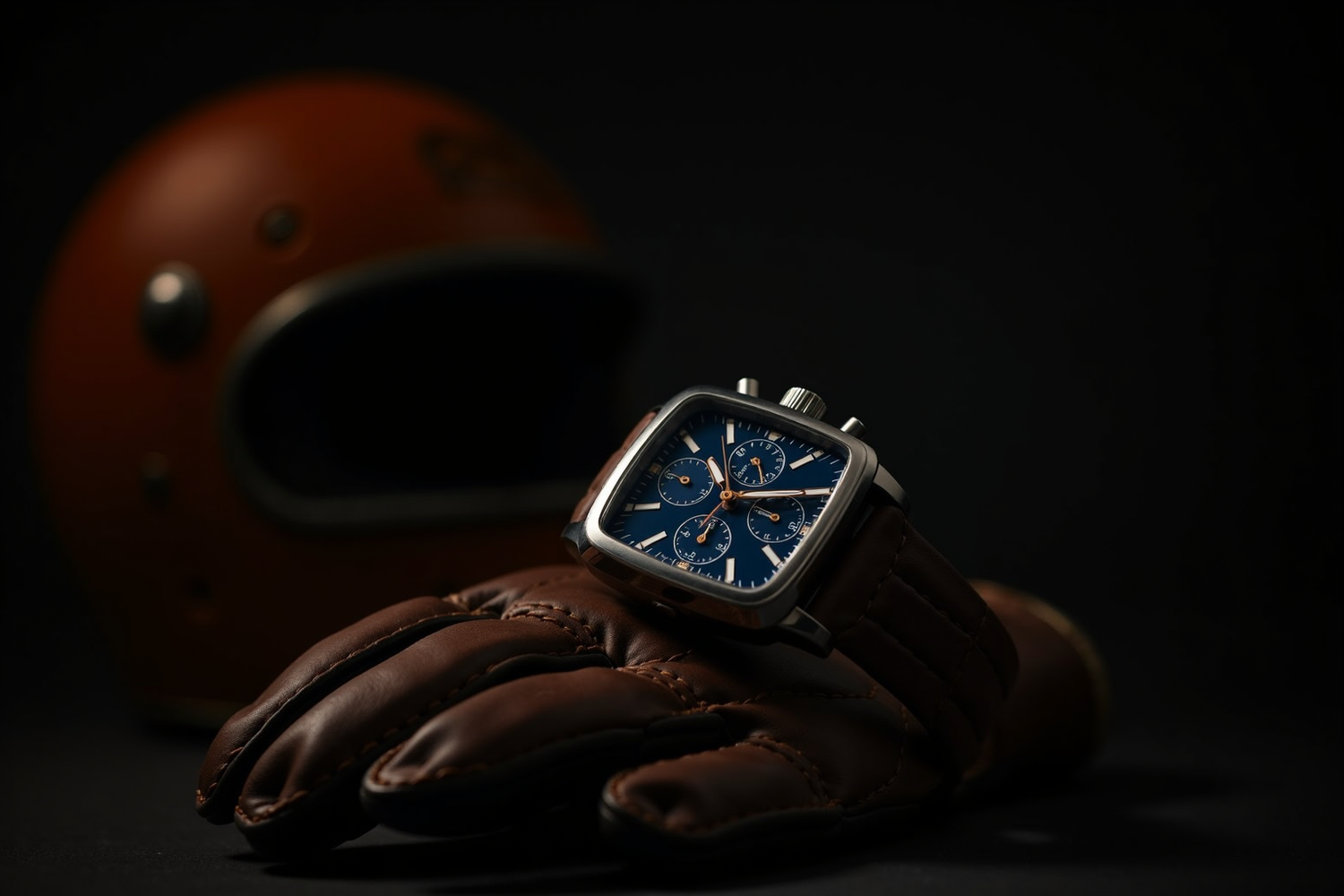

In the summer of 1970, a Hollywood actor with grease under his fingernails strapped on a square-cased chronograph and walked onto a film set at Le Mans. He had no idea he was about to make horological history. Fifty-six years later, that watch — the Heuer Monaco — is still one of the most recognizable timepieces on the planet, and the man who made it famous is still the gold standard of cool.
A Square Peg in a Round World
When Jack Heuer unveiled the Monaco at simultaneous press conferences in New York and Geneva on March 3, 1969, he was making a calculated bet against everything the watch industry believed. Round was safe. Round was tradition. Round was what people bought. The Monaco was none of those things.
The case was unapologetically square — a hard-edged 39mm cube of polished steel, the first water-resistant square chronograph case in history, designed by Erwin Piquerez of Switzerland. The dial was metallic blue, a color choice so unusual at the time that several retailers initially refused to stock it. The crown was on the left side of the case, an engineering quirk that telegraphed something specific: this watch did not need to be wound. Inside it was the Calibre 11, the world's first automatic chronograph movement, developed jointly by Heuer-Leonidas, Breitling, Hamilton-Büren, and Dubois-Dépraz in a desperate sprint to beat Zenith's El Primero and Seiko's 6139 to market.
It was, by every conventional measure, a difficult watch. Too square. Too blue. Too weird. For its first eighteen months on shelves, sales were a polite disappointment.
Enter Steve McQueen
In June 1970, Steve McQueen was deep into pre-production on Le Mans, his obsessive love letter to endurance racing. He wanted everything authentic — the cars were real, the drivers were real, the danger was real. (Several stunt drivers were seriously injured during filming. McQueen himself spent time in the cockpit of a 917K at speed.) He needed a watch that a real driver of that era might actually wear.
The story, as told by costume designer Ray Summers and confirmed in later interviews, is that McQueen was inspired by his friend Jo Siffert, the Swiss Formula One driver who was sponsoring the production and wearing Heuer on his racing suit. McQueen wanted to honor Siffert. He looked through a tray of Heuer watches and picked the strangest one in the box.
The Monaco wasn't a logical choice. Drivers of the era almost universally wore round chronographs — Carreras, Autavias, the Rolex Daytona. The square case was an outlier. But McQueen liked outliers. He chose the reference 1133B with the blue dial, strapped it on, and wore it for every cockpit scene in the film.
How a Movie Saved a Watch
Le Mans was a commercial failure when it released in 1971. It made back barely half its budget. Critics called it cold, plotless, and self-indulgent. McQueen's career took a hit. The film vanished from theaters within months.
But something strange happened in the decades that followed. Le Mans became a cult masterpiece — the film that motorsport people watched on loop, the film that inspired Ron Howard's Rush and James Mangold's Ford v Ferrari. And every time someone watched it, they saw McQueen in his white Gulf-liveried driving suit, sleeves rolled, square blue watch on his left wrist, eyes locked on the apex.
The Monaco didn't just survive its rough launch. It became a shorthand for a specific kind of confidence — the kind that doesn't need to explain itself.
The Strange Power of an Unconventional Case
What McQueen understood, almost certainly by instinct rather than horological analysis, is something that watch designers have wrestled with for a century: a square or unusually-shaped case forces the wearer to commit. A round watch is invisible. It blends. It can sit on any wrist, with any outfit, in any decade. A shaped case is a statement. It says I chose this on purpose.
This is why so few brands attempt non-round cases at scale, and why the ones that do — Cartier's Tank, the Patek Nautilus, the Audemars Royal Oak — tend to become signatures rather than products. They're harder to sell, but once they connect with a person, they become permanent.
It's a philosophy independent watchmakers understand intimately. The Grandeur Strange V3, with its asymmetric jumping-hour aperture and stone dial face, is built on the same principle: a case shape and dial layout that refuses to apologize. It's not for everyone, and that's the point.
The Monaco's Afterlife
TAG Heuer (which acquired Heuer in 1985) has reissued the Monaco countless times — in titanium, in carbon, in skeletonized form, in tourbillon configurations that would have made Jack Heuer's 1969 accountants faint. The original 1133B references now trade at auction for $80,000 to $1.2 million depending on provenance. The single Monaco that McQueen actually wore on screen — verified by production photos and the actor's own letter to his stunt double Haig Altounian — sold at Phillips in 2020 for $2.2 million.
The watch that almost died in 1970 is now one of the most replicated, referenced, and revered designs in horology. Not because it was perfect. Because it was strange enough to mean something.
Why This Story Still Matters
The Monaco's path from commercial flop to cultural monument is a reminder of something the watch industry sometimes forgets: a great watch is not the one that sells the fastest. A great watch is the one that, decades later, still feels like the person wearing it made a choice.
McQueen didn't pick the Monaco because it was popular. He picked it because it wasn't. That choice — that small act of taste exercised on a hot June morning in 1970 — is what every honest watch collector is chasing. Not the watch on the spec sheet. The watch on the wrist of someone who knew exactly what they were doing.
That's the real complication. And no automatic movement has ever replicated it.
Featured Watch
Grandeur Strange V3 — Stone Dials
Like the Monaco, the Strange V3 refuses to apologize for its shape. An asymmetric jumping-hour case with hand-cut stone dials — built for the wearer who picks the strangest watch in the box.
Explore the Grandeur Strange V3 →


Leave a comment
This site is protected by hCaptcha and the hCaptcha Privacy Policy and Terms of Service apply.