
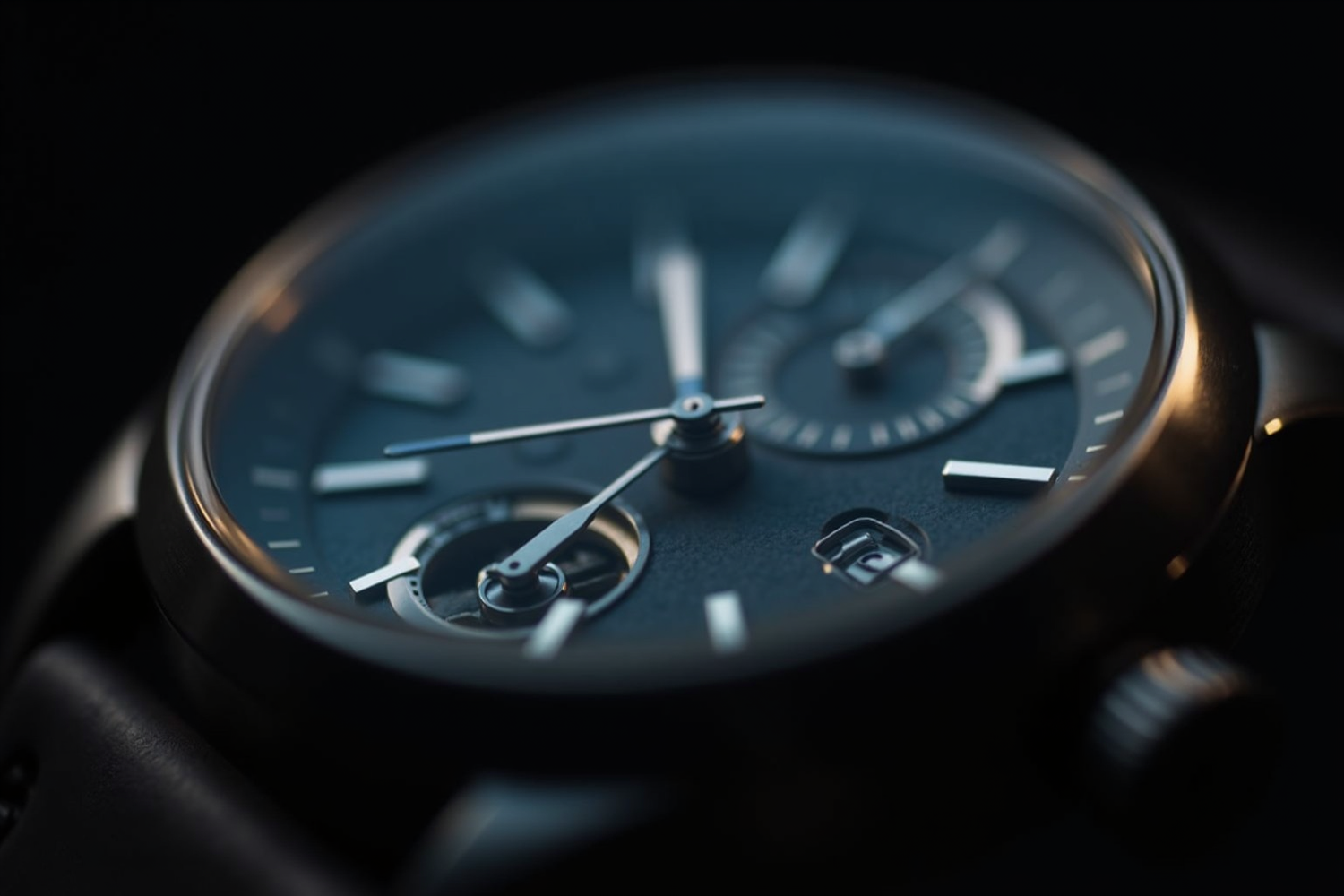

Look at the watch on your wrist. The clearest, most invisible part of it — the window over the dial — is almost certainly the second-hardest material on Earth, grown one crystal at a time inside a furnace running at 2,050°C. We barely think about it. We should.
The Quiet Revolution Above the Dial
Sapphire crystal is the great unsung component of modern watchmaking. It does not tick, swing, or chime. It has no jewels, no finishing, no maker's mark. And yet without it, the rest of the watch — the perpetual calendar, the tourbillon, the hand-engraved bridges — would be at the mercy of every keychain, doorframe, and granite countertop a wearer encountered.
For most of horology's history, the answer to "what protects the dial?" was either glass (fragile) or acrylic plastic (scratch-prone, but cheap and easy to polish). Sapphire didn't appear in serial watch production in any meaningful way until the 1960s, and it didn't become the default for luxury watches until the 1980s. In horological time, that's basically yesterday.
It Isn't a Sapphire. Not Really.
The "sapphire" in your watch shares almost nothing with the blue gemstone in a ring. Both are corundum — crystalline aluminum oxide (Al2O3) — but the watchmaker's version is grown synthetically, deliberately colorless, and chemically purer than anything pulled from the ground.
The reason is simple: optical clarity. Mined sapphire contains trace iron and titanium, which is what gives gem-grade stones their blue color. Watchmakers don't want color. They want a window. So labs grow synthetic corundum crystals from high-purity alumina powder, producing a transparent material with none of nature's romantic imperfections — and all of its hardness.
The Mohs Scale Brag
On the Mohs hardness scale, diamond sits at 10. Sapphire sits at 9. Hardened steel hovers around 6.5. The keys in your pocket, the marble on a hotel bathroom sink, the tile of a kitchen floor — none of them can scratch sapphire under normal contact. Only diamond, silicon carbide, and a handful of exotic abrasives can.
That single property — near-immunity to scratches — is why sapphire became the standard. A mineral glass crystal will haze within a year of daily wear. An acrylic crystal will look like a fogged windshield within five. A sapphire crystal, if it isn't physically impacted hard enough to shatter, looks the same on year fifty as it did the day it left the workshop.
How Sapphire Crystals Are Actually Made
The most common method is the Verneuil process, invented in 1902 and still in use because it is staggeringly efficient. Powdered alumina is dropped through an oxyhydrogen flame burning at over 2,000°C, melting onto a slowly rotating ceramic seed. The melt cools and crystallizes into a "boule" — a single, cylindrical crystal that can weigh several kilograms.
For higher-grade applications, including the largest and clearest watch crystals, manufacturers use the Kyropoulos or Czochralski methods, which grow the crystal more slowly from a molten bath. The slower the growth, the fewer internal stresses, the better the optical performance. Some Czochralski-grown boules destined for premium watchmaking take a full week to grow.
Once the boule is formed, it is sliced — carefully, because corundum's hardness eats through ordinary tooling — using diamond saws. Each disc is then ground, polished, and shaped: flat, slightly domed, double-domed, or "box" (with vertical sidewalls), depending on the watch design. The grinding alone can take hours per piece.
Anti-Reflective Coating: The Last 10%
Untreated sapphire reflects roughly 8% of incoming light, which is why a bare sapphire crystal under harsh lighting can look mirror-like. To kill those reflections, manufacturers apply micro-thin layers of magnesium fluoride or silicon dioxide to one or both sides. These coatings are measured in nanometers and tuned to specific wavelengths.
If you've ever picked up a watch and felt as if the dial were floating freely — with no glass between you and the hands — you were looking through a double-sided AR-coated sapphire crystal. The crystal is still there. It's just doing its job so well it has stopped existing visually.
Where the Material Has Limits
Sapphire is hard, but it is also brittle. A direct strike on a sharp edge — the corner of a granite countertop, a steel railing, a hammer in a moment of catastrophic clumsiness — can crack or shatter it. This is the trade-off the entire industry has made: in exchange for near-perfect scratch resistance, you accept slightly lower impact resistance compared with acrylic.
That brittleness is also why sapphire crystals are surprisingly thick — often 1.5 to 3.0 mm on luxury pieces, even more on dive watches and box-crystal designs. The thickness isn't aesthetic. It's structural insurance.
For divers' watches certified to extreme depths, sapphire is paired with steel or ceramic bezels precisely so the bezel takes the side impact and the crystal only ever sees pressure from above — pressure it handles superbly.
Sapphire as Frame, Not Just Window
The most exciting use of sapphire in modern watchmaking isn't on top of the dial — it's around it. Independent makers and avant-garde brands now produce entire watch cases out of sapphire, machined from solid blocks. Each case can require dozens of hours of CNC milling with diamond tools and consume blocks of sapphire many times the size of the finished part.
The result is a watch that floats, visually, on the wrist. The movement is fully exposed, finished on every face the eye can reach, and surrounded by an invisible fortress that just happens to be one of the hardest materials humans can manufacture.
This is also where sapphire dials begin to enter the picture — thin, transparent, sometimes tinted plates that let the wearer see straight through the dial to the gear train below. They are difficult to make and harder to finish, but the visual effect is unmatched: the watch becomes a transparent machine, with sapphire doing the work of dial, crystal, and case all at once.
Featured Watch
Grandeur Strange V3 — Stone Dials
A flawless sapphire crystal is what makes a stone dial possible. It protects the fragile mineral surface while showcasing every grain, vein, and natural inclusion in perfect optical clarity.
Explore Strange V3 Stone Dials →Why It Matters for Collectors
If you're buying a luxury watch in 2026, the presence of sapphire is no longer a luxury feature — it's table stakes. Almost every mechanical watch over a few hundred dollars uses sapphire on top, and most use it on the case-back too. What separates good from great is detail: thickness, doming, anti-reflective coating quality, edge polish, and how cleanly the crystal seats into the case.
Look closely at any serious watch and you'll see those details. Tilt the watch under a lamp: a well-finished sapphire crystal has crisp, mirror-clean edges where it meets the bezel, with no chipping and no glue line. Its dome (if any) is symmetrical. Its AR coating is uniform, with no faint rainbowing in patches. These are the fingerprints of a workshop that cared.
And finally, sapphire ages beautifully — which is to say, it doesn't age at all. Twenty years from now, every other component in your watch will have been serviced, lubricated, replaced, or refinished. The crystal is the one part you may never have to think about again. It will still be doing exactly what it was made to do: holding back the world, invisibly, so the artistry beneath it can be seen.

Leave a comment
This site is protected by hCaptcha and the hCaptcha Privacy Policy and Terms of Service apply.