
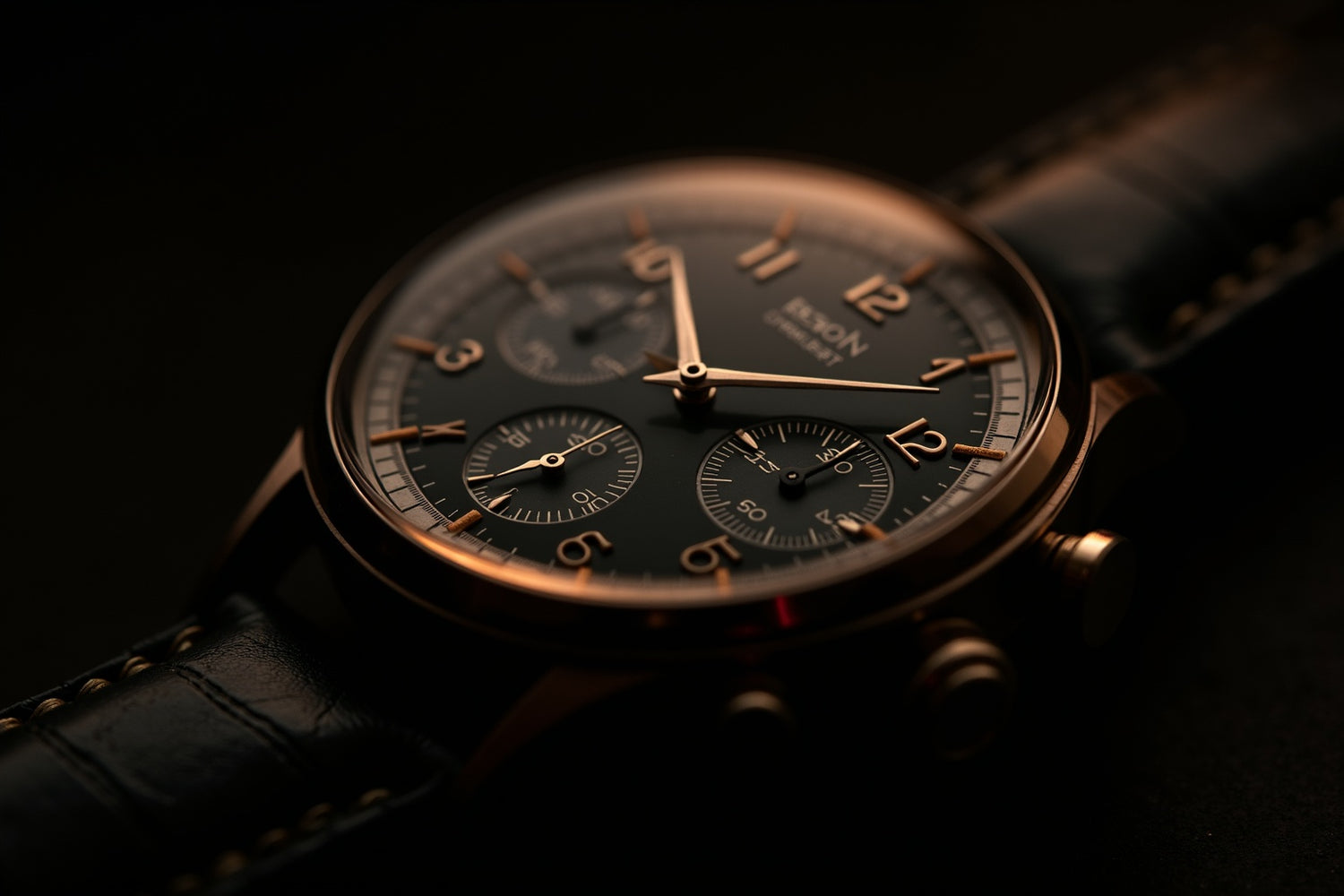
In October 2017, a stainless-steel wristwatch sold at Phillips auction in New York for $17.8 million. It was not gold. It had no diamonds. It contained roughly $30 worth of base materials. Yet a single Rolex Daytona — a model that languished unsold in shop windows for nearly a decade — became the most expensive wristwatch ever auctioned at the time. The story of how that happened is one of the strangest, most instructive tales in modern horology.
A Chronograph Nobody Wanted
Rolex introduced the Cosmograph Daytona in 1963, designed as a tool watch for race-car drivers. The Daytona had a tachymeter bezel for calculating speed, three subdials for chronograph timing, and a robust manual-wind movement supplied by Valjoux. By every objective measure, it was a precision instrument.
The market disagreed. Through the 1960s and into the 1970s, the Daytona sold poorly. Authorized dealers reportedly bundled them with Datejusts as "if you take this, I'll throw in a Daytona" incentives. Rolex periodically considered discontinuing the line.
Among the slowest-selling variants was a particular dial configuration produced between roughly 1963 and 1969. It featured an unusual layout: Art Deco-style block numerals on the subdials, a contrasting outer minute track, and small squared-off markers at the registers. Internally, Rolex referred to these dials as "exotic." Customers found them too quirky, too busy, too unlike a proper chronograph. Most exotic dials were swapped out for standard versions during routine service. They are, by any reasonable definition, design failures.
Enter Paul Newman
In 1968, the actress Joanne Woodward gave her husband — actor and amateur racing driver Paul Newman — a Rolex Daytona reference 6239 with one of those exotic dials. Engraved on the caseback was the phrase "Drive Carefully Me." Newman wore it constantly, on screen and off, for over three decades.
Photographs of Newman wearing the watch — at Le Mans, in pit lanes, in candid airport shots — circulated through the 1980s and 1990s in racing magazines and Italian collector publications. Italian collectors, who were among the first to take vintage Rolex seriously as a category, started calling the exotic-dial Daytonas "Paul Newman" dials. The nickname stuck. By the late 1990s, what Rolex had once considered an unsellable design was the most desirable variant of any vintage Daytona.
Why the Nickname Mattered
Watch collecting runs on narrative as much as on metallurgy. A Paul Newman dial is mechanically identical to a standard Daytona dial of the same era. The case, the movement, the bracelet — all the same. The only difference is the painted dial face. Yet that single component, attached to the right story, multiplied the watch's value by ten, then by a hundred, then by more than a thousand.
This is the lesson collectors keep relearning: provenance and cultural attachment can outweigh every objective measure of a watch's worth. A Daytona without the exotic dial is a fine vintage chronograph. A Daytona with one is a piece of pop-culture sculpture.
The $17.8 Million Watch
For decades, collectors assumed Paul Newman's actual personal Daytona — the original 1968 reference 6239 — had been lost. Newman was famously private and rarely discussed his collection. Then, in 2017, his daughter Nell and her then-boyfriend James Cox, to whom Newman had given the watch in 1984, announced they would auction it.
Phillips' auction house in New York handled the sale on October 26, 2017. Bidding lasted twelve minutes. The hammer price was $15.5 million; with buyer's premium, the final figure reached $17,752,500. The buyer was anonymous. At the time, it was the most ever paid for a wristwatch at auction — a record later broken by Patek Philippe pieces, but never by another Rolex.
What Made This Specific Watch Different
Several factors stacked the deck:
- Direct provenance. Photographs and engraving placed this exact watch on Newman's wrist for sixteen years.
- Unrestored condition. The dial, hands, and case were original — a rarity for a watch worn daily.
- Documented chain of custody. Newman gave it to Cox personally; the family confirmed the gift.
- Cultural momentum. By 2017, "Paul Newman Daytona" had become shorthand for everything aspirational about vintage watch collecting.
Strip away any one of those, and the price collapses. A Paul Newman Daytona without celebrity provenance trades, today, in the $200,000 to $1.2 million range depending on reference, condition, and dial variant. Still extraordinary money. Still a fraction of $17.8 million.
Lessons for Collectors
The Newman story is often told as a fairy tale: ugly duckling watch becomes king. But there are concrete takeaways for anyone serious about collecting.
First, taste shifts. The features that make a watch unsellable in one era can make it priceless in another. Brutalist 1970s designs that gathered dust for decades — Genta-designed integrated bracelets, asymmetric cases, unusual dial textures — are now among the most sought-after vintage pieces. The market rewards patience and contrarian eye.
Second, narrative compounds. A watch with a story — a celebrity wearer, a documented expedition, a presentation engraving — almost always outperforms an identical watch without one. This is why provenance research has become its own discipline within auction houses.
Third, originality is irreplaceable. Newman's watch survived because nobody serviced it into "improvement." The instinct to polish a case or swap a faded dial for a fresh one has destroyed more value than any other single act in vintage collecting.
The Independent Watchmaker's Footnote
There's a quieter lesson buried in the Newman story, one that matters for anyone watching today's market. The Daytona became valuable not because Rolex marketed it well — they were ready to drop it — but because a small community of collectors recognized something in a design the establishment had dismissed.
The same dynamic plays out now in independent watchmaking, where small studios produce mechanically ambitious pieces in tiny series. A patented complication, a hand-finished dial, a case forged from an unusual alloy — these things rarely register on the broad market at launch. They tend to be appreciated late, and then suddenly. At Grandeur USA, our LUMILLION lume tourbillon and the Strange V3 stone-dial collection are built with that long view in mind: design choices that may look unconventional today, made to be wearable now and meaningful later.
Paul Newman's Daytona is the most extreme version of a recurring story. Real watches, worn by real people, finishing somewhere none of their original buyers — or makers — could have predicted.
Featured Watch
LUMILLION — Independent Watchmaking
The Paul Newman lesson applies directly to pieces like the LUMILLION: a genuinely novel complication (world's first lume tourbillon), a small production run, and design choices that may look unconventional today — built with the long view in mind.
Explore LUMILLION — Independent Watchmaking →








Leave a comment
This site is protected by hCaptcha and the hCaptcha Privacy Policy and Terms of Service apply.