
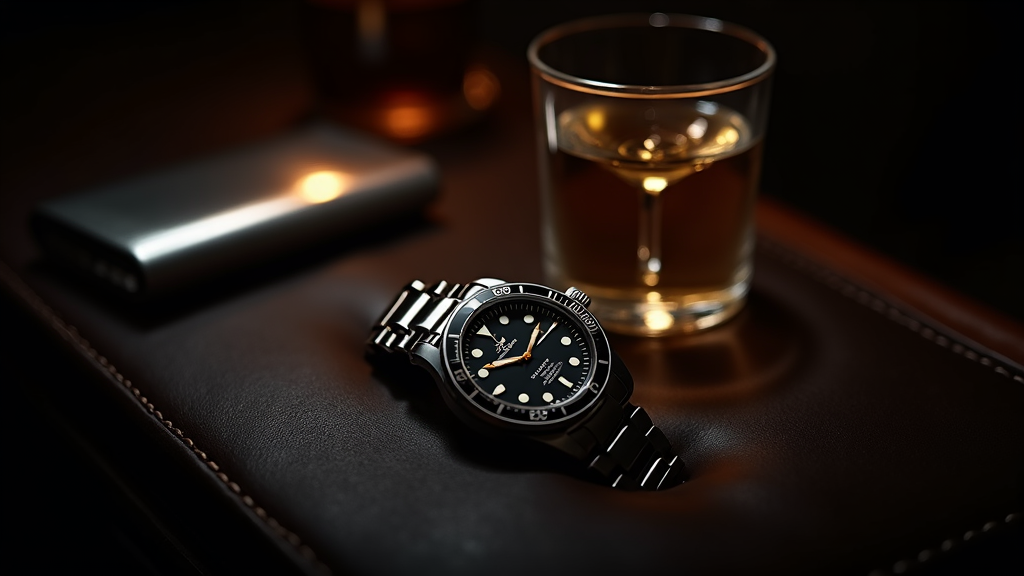
Few characters in cinematic history are more inseparable from their wristwear than James Bond. For over six decades, 007 has made watches cool in a way no advertising campaign ever could — transforming utilitarian dive tools into aspirational objects, and later turning a struggling Swiss brand into a global powerhouse. The Bond watch story is really two stories: the accidental icon (the Rolex years) and the manufactured icon (the Omega era). Both are fascinating, and together they explain how a prop became a cultural artifact.
The Rolex Years: An Accidental Icon
In 1962, Sean Connery walked onto the set of Dr. No wearing a Rolex Submariner reference 6538. There was no sponsorship deal. There was no product placement budget. According to the widely repeated account, producer Albert “Cubby” Broccoli simply handed Connery his own watch because the actor’s wrist looked bare on camera. That offhand wardrobe decision would echo for sixty years.
The Submariner 6538 — the “Big Crown” Sub — wasn’t chosen for its elegance. It was chosen because it looked like something a naval intelligence officer would actually wear. And that authenticity mattered. Ian Fleming himself wore a Rolex Explorer, and in his novels Bond’s watch was described in deliberately understated terms: a tool, not jewelry. The 6538 on Connery’s wrist reinforced that ethos. Bond wasn’t flashy. Bond was competent. The watch said so.
Over the following decades, Bond rotated through several Rolex Submariner references — the 6538, the 5513, the 1680 — along with occasional detours into the Breitling Top Time (Thunderball, 1965) and even a Hamilton Pulsar digital (Live and Let Die, 1973). But the Submariner remained the definitive Bond watch for a generation. Roger Moore’s 5513 even got modified in Live and Let Die with a buzzsaw bezel and magnetic field generator — a playful nod to the watch’s status as, quite literally, a tool of the trade.
The Omega Pivot: A Deliberate Icon
Everything changed in 1995. When GoldenEye rebooted the franchise with Pierce Brosnan, costume designer Lindy Hemming made a decisive call: Bond would now wear the Omega Seamaster Professional 300M Quartz, reference 2541.80. The reasoning, as Hemming has explained in interviews, was that a British naval commander — which Bond technically is — would realistically wear a Seamaster. It was practical, understated, and European without being ostentatious.
For Omega, this was a generational opportunity. The brand had spent the 1970s and 1980s fighting the quartz crisis, and while the Speedmaster had the moon landing legacy, the Seamaster was a relatively quiet pillar of the catalog. Post-GoldenEye, demand for the blue-dialed Seamaster exploded. Omega leaned into the partnership, and by the Daniel Craig era, the Bond-Omega relationship had matured into one of the most successful long-term product associations in film history.
The watches themselves evolved alongside Bond. The quartz Seamaster gave way to automatic movements. Sword-shaped hands and wave-patterned dials became house signatures. By No Time to Die (2021), Craig wore the Seamaster Diver 300M “007 Edition” in grade 2 titanium with a tropical brown aluminum bezel, co-designed with Craig himself. It was a vintage-inspired, lightweight tool watch — a deliberate callback to the Connery-era philosophy of “Bond wears a tool, not a trophy.”
Why It Worked: The Anatomy of a Watch Icon
The Bond-watch phenomenon works because it honors three principles that serious collectors instinctively respect:
- Restraint over flash. Bond’s watches have almost always been sport watches, not dress watches. Divers, chronographs, and field-adjacent designs. The message is always utility first.
- Continuity with variation. The watch changes, but the archetype doesn’t. It’s always a capable, no-nonsense timepiece on a metal bracelet or NATO. You could trace a straight line from 1962 to today.
- Character, not celebrity. Bond doesn’t wear the watch to show off wealth. He wears it because he needs it. That fictional logic is what keeps the appeal grounded.
The NATO Strap Moment
One sub-plot deserves its own mention: the NATO strap. When Connery’s Submariner appeared on a striped nylon band in Goldfinger (1964), it sparked decades of collector debate about whether it was a “real” NATO (it wasn’t — real NATOs didn’t exist yet), what the correct colors should be, and why the lugs looked mismatched. That single wardrobe choice gave birth to an entire cottage industry of strap makers and a strap style that’s now standard issue on almost every enthusiast’s watch roll.
What Bond Teaches Modern Watchmaking
The deeper lesson of the Bond watch isn’t about brands — it’s about character. A watch becomes iconic not because it’s expensive or complicated, but because it fits a coherent story. The Submariner worked because it matched Connery’s cold professionalism. The Seamaster worked because it matched Brosnan’s urbane polish and Craig’s rougher edge.
For independent watchmakers, this is the blueprint. A watch with a clear identity — a design philosophy, a material choice, a complication with real meaning — will always outlast a watch chasing trends. At Grandeur USA, that idea runs through everything we make. The LUMILLION Lume Tourbillon, for instance, doesn’t exist because tourbillons are fashionable. It exists because it solves a real problem (a tourbillon you can actually read in the dark) and does it with a specific material palette: TC4 titanium, Damascus aluminum, Swiss BGW9 luminescence. That’s the Bond lesson. Tool first, character second, flash never.
The Next Chapter
With Daniel Craig’s departure, the Bond wardrobe is up for grabs again. Omega has the incumbent advantage, and twenty-plus years of brand equity are hard to dislodge. But film partnerships are famously volatile, and nothing is permanent. Whoever the next Bond turns out to be, his watch will be studied, photographed, debated, and — inevitably — sold out within hours of the film’s premiere.
That, more than anything, is the real legacy of the Bond watch: the proof that a small object on a wrist, shot in the right light, can shape taste for generations. It’s the most persuasive watch advertisement ever made, and it was never technically an advertisement at all.
Featured Watch
TorQ Mechanical — Tantalum Edition
The Bond ethos was always 'tool first, trophy never.' The TorQ Mechanical Tantalum earns that description: rare metal, serious construction, and an in-house movement — no celebrity endorsements, no marketing inflations.
Explore TorQ Mechanical — Tantalum Edition →

Leave a comment
This site is protected by hCaptcha and the hCaptcha Privacy Policy and Terms of Service apply.