
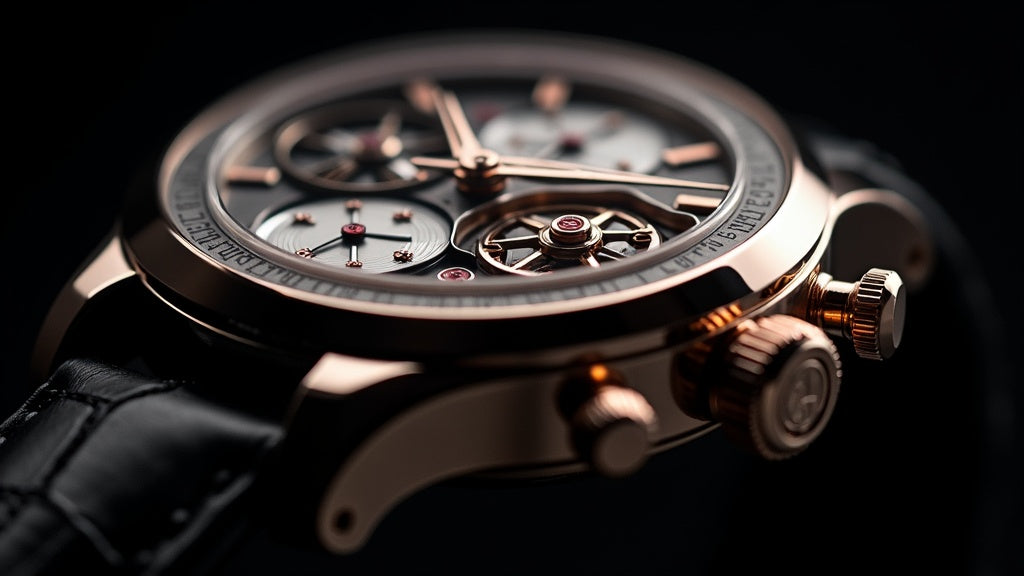
Press the top pusher. A second hand sweeps to life from twelve, gliding across the dial in a single, fluid motion. Press it again — it freezes mid-air. A third press, and it snaps back to zero with the precision of a guillotine.
That little ritual, performed millions of times each day on wrists around the world, is one of mechanical horology's quiet miracles. The chronograph is a stopwatch grafted onto a wristwatch — and getting those two ideas to coexist inside a thirty-millimeter movement is harder than it has any right to be.
What Exactly Is a Chronograph?
A chronograph (Greek: chronos, time + graphein, to write) is a watch that can measure elapsed intervals independently of the running time. Press start, press stop, press reset. The base movement keeps ticking the whole time — your watch never stops being a watch.
People often confuse the term with "chronometer," which has nothing to do with stopwatches at all. A chronometer is a precision-certified timekeeper (think COSC certification). A chronograph is a function. A watch can be both, neither, or one of the two — they're entirely different concepts that just happen to share four letters.
A Brief Genealogy
The first true chronograph appeared in 1816, when French watchmaker Louis Moinet built a device capable of measuring 1/60th of a second to track astronomical events. For nearly two centuries, his name was lost to history — Nicolas Rieussec was credited as the inventor in 1821 for a clever device that "wrote" elapsed time by depositing a drop of ink on a rotating dial. (That's literally where chronograph — "time writer" — gets its name.)
Wristwatch chronographs arrived in earnest in the 1910s, and by 1969 three teams were racing to build the first automatic chronograph: Zenith with the El Primero, Seiko with the 6139, and a Heuer-Breitling-Hamilton-Dubois Dépraz consortium with the Caliber 11. All three claim to have crossed the line first. Watch nerds have been arguing about it ever since.
The Hard Part: Stacking a Stopwatch on a Watch
Here's the engineering puzzle. A normal mechanical watch has a single power source — the mainspring — driving a single train of gears that turns the hands. A chronograph needs to borrow energy from that same mainspring on demand, route it to a second set of hands, then disconnect cleanly without disturbing timekeeping.
That's three problems, really:
- Coupling — how do you engage the chronograph train smoothly without making the seconds hand "jump" when you start it?
- Reset — how do you snap multiple hands back to exactly zero, instantly, without bending anything?
- Isolation — how do you keep the chronograph's drag from killing the watch's accuracy when it's running?
Watchmakers have spent two centuries arguing about the elegant answers.
Column Wheel vs. Cam: The Eternal Debate
The mechanism that translates pusher presses into start-stop-reset commands is the switching system. There are two main approaches.
The Column Wheel
The column wheel is the connoisseur's choice — a tiny tower of vertical pillars (usually six or eight) that rotates a notch with each pusher press. Levers ride against those columns, falling into the gaps to engage and climbing up to disengage. The result is a buttery, low-friction action that feels like cocking the hammer of a finely tuned revolver.
The downside? Column wheels are brutally expensive to make. Each pillar must be milled and hardened to micron tolerances. Get one wrong and the entire wheel is scrap.
The Cam (or Coulisse Lever)
The cam system, popularized in the 1940s as a cost-cutting alternative, replaces the column wheel with a flat shuttle that slides back and forth. It's mechanically robust, easier to manufacture, and frankly works just fine — the legendary Valjoux 7750 (still powering thousands of chronographs today) uses a cam.
Connoisseurs will tell you they can feel the difference at the pusher. They're often right, but the difference is smaller than the price gap suggests.
Horizontal vs. Vertical Clutch
The other big design choice is how the chronograph train engages the running gear train. The horizontal clutch uses two gears that mesh sideways when activated — beautiful to watch through a display caseback, but it can cause that subtle "stutter" of the seconds hand on engagement, and the meshing teeth eventually wear.
The vertical clutch, pioneered in modern form by Seiko in the late '60s and refined by Rolex in the Daytona's caliber 4130, uses friction discs stacked vertically — like a tiny automotive clutch. Engagement is instant, smooth, and can be left running indefinitely without wear. The trade-off: it's harder to admire through the back, and the architecture is significantly more complex.
Today, most premium chronographs combine a column wheel and a vertical clutch. It's the hi-fi audiophile combo — the best of both worlds, at a price.
Reading the Dial
A typical chronograph dial has the central seconds hand (the chronograph hand, not the watch's running seconds), plus subdials called totalizers that count elapsed minutes and hours. Some dials add a tachymeter scale around the bezel — a clever conversion chart that turns elapsed seconds into speed-over-distance. Time how long a mile takes, read the number on the bezel, and you've got your average speed in mph. It's why chronographs and motorsports are joined at the hip.
The classic three-register layout (typically at 3, 6, and 9 o'clock) is sometimes called the "tri-compax." Two-register (3 and 9) chronographs have a cleaner, more vintage feel — think early Heuer Carreras and the Speedmaster's predecessors.
Why Chronographs Still Matter
In a world where every phone has a stopwatch accurate to the millisecond, why bother with a mechanical one? The same reason you'd bother with a manual transmission in 2026 — because it's a piece of mechanical theater you wear on your wrist. Pressing a chronograph pusher engages dozens of components in a precisely choreographed sequence. The click is a signature. The sweep is a small ceremony.
And there's the cultural weight: chronographs landed on the moon (Omega Speedmaster), set Le Mans lap records (Heuer Carrera), and timed Cold War spy operations (the Russian Strela). Every chronograph carries a fragment of that history.
The Grandeur Take
At Grandeur USA, our focus has been on a different obsession — reinventing how time is displayed rather than how intervals are measured. The Aureus Strata and our Strange Hours collection use jumping-hour and wandering-hour complications to break the tyranny of the conventional dial. Different problem, same spirit: take a centuries-old mechanical idea and give it a fresh voice.
The chronograph is one of those eternal puzzles in horology — solved a thousand different ways, never quite finished. Every generation of watchmakers takes another swing at it. And every time you press that top pusher and watch the hand sweep to life, you're firing a mechanism that's been refined, argued over, and lovingly improved for more than two hundred years.
Not bad for a stopwatch on a strap.
Featured Watch
Grandeur USA Independent Watches
Grandeur doesn't make chronographs — yet. What we do make are watches that push mechanical display as far as it can go: jumping hours, lume tourbillons, chiming repeaters, retrograde arcs. Explore the collection.
Explore Grandeur USA Independent Watches →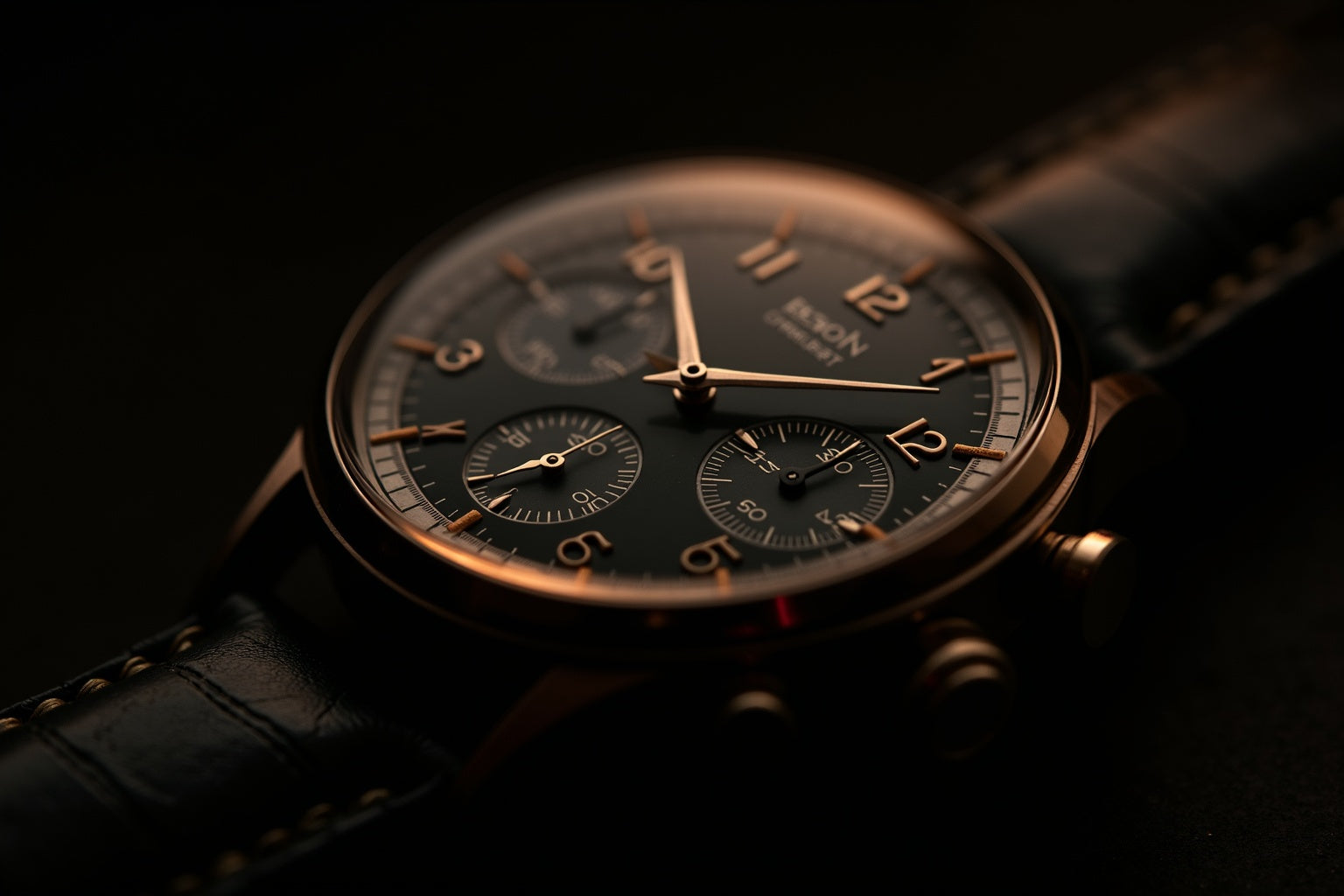

Leave a comment
This site is protected by hCaptcha and the hCaptcha Privacy Policy and Terms of Service apply.