
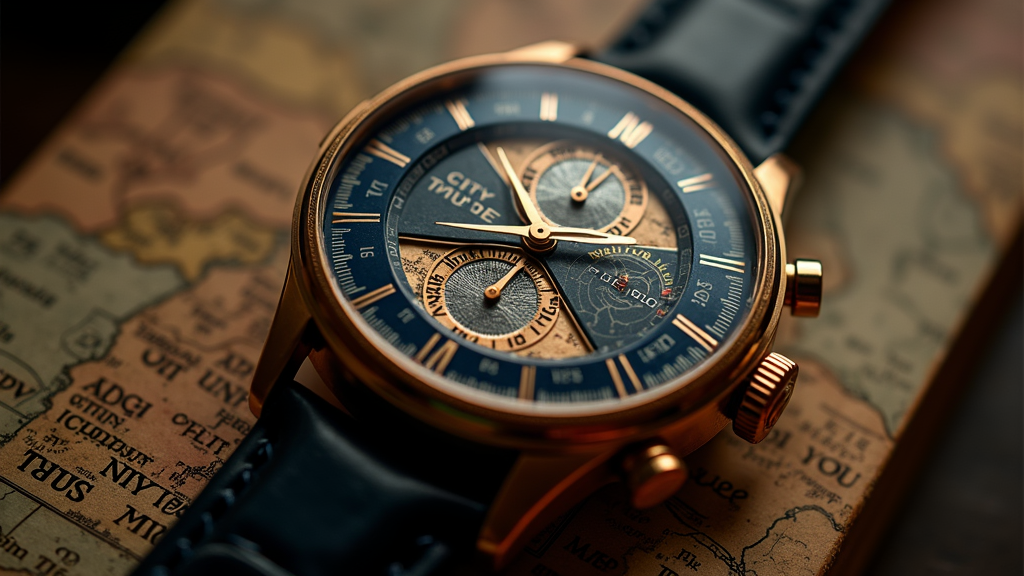

A wristwatch is a small machine asking a small question: what time is it right now? A world time watch asks something audacious — what time is it everywhere, all at once? It is one of horology's most romantic complications, and one of the most quietly difficult to execute well. To wear one is to carry twenty-four cities on your wrist, each ticking through its own dawn while you sip coffee in another.
The Geometry of the World on a Dial
The world time complication, often called heures universelles in its native French, displays the current time in every one of the world's twenty-four standard time zones simultaneously. Its anatomy is elegant once you understand it. The outer edge of the dial carries a rotating ring printed with the names of twenty-four reference cities — Paris, London, New York, Tokyo, Dubai, Sydney, and so on — one for each time zone. Inside that, a second rotating ring is divided into twenty-four hours, usually with a graphical day/night gradient: daylight hours bright, nighttime hours rendered in deep blue or black.
The center of the dial shows the time in your local reference city via conventional hour and minute hands. The 24-hour disc, geared to the hour hand, rotates once per day. By looking at any city on the outer ring, you can read off the hour aligned with it on the 24-hour disc — and instantly know not only what time it is in Singapore but whether the sun is up there.
It is a piece of analog computing so intuitive that, once you have used one for a week, the digital alternative feels strangely impoverished. A phone tells you "Singapore: 9:42 PM." A world time watch tells you Singapore is asleep.
Louis Cottier and the Birth of a Complication
The world time complication as we know it was invented in the 1930s by a Geneva watchmaker named Louis Cottier. Cottier was not the head of a famous brand. He worked from a small workshop and supplied modules to others. But his invention — patented in 1931 — became the architectural template for almost every world timer made since.
The 1884 Problem
To appreciate why Cottier's invention mattered, you have to remember what 1884 did to the world. That year, the International Meridian Conference in Washington carved the globe into twenty-four standard time zones radiating from Greenwich. Before that, "noon" had been a local affair, defined by when the sun crossed the local meridian. Railroads, telegraphs, and steamships had made local time chaos intolerable. Standardization solved the chaos but created a new puzzle: how does one display the new world?
For fifty years after 1884, the answer was clumsy. Multi-dial pocket watches showed two or three time zones with separate subdials, each requiring independent setting. They worked, but they were not elegant. Cottier's stroke of genius was to recognize that all twenty-four time zones move together. If you rotate one disc representing 24 hours, every city moves with it.
Cottier's Patek Philippe Years
By the late 1930s, Cottier was supplying world time modules to the Geneva grandees: Vacheron Constantin, Rolex, and most famously Patek Philippe. The references he helped produce — Patek's 1415 HU and later the iconic 2523 — are now among the most coveted vintage watches on earth. A single 1953 Patek 2523 with a cloisonné enamel map dial sold at auction in 2019 for more than nine million Swiss francs. The mechanism inside is, in essence, Cottier's 1931 design.
The Subtle Engineering Beneath the Romance
Look at a world timer and the complication seems almost obvious — a couple of rotating discs, what could be so hard? The difficulty is in the details.
The Crown-Adjustment Problem
Early world timers required the wearer to set the rotating city ring manually using a second crown or a recessed corrector. Modern world timers — pioneered by Patek's caliber 240 HU in 2000 — let you advance the city ring forward by single steps using only the main crown, automatically jumping the hour hand and the 24-hour disc in perfect synchrony. To change time zones in the morning, you press a pusher once. The city under the marker changes, the hour hand jumps an hour, the 24-hour disc rotates 15 degrees. Three motions, one button. The gearing required to make that mechanical handshake reliable, repeatable, and resistant to shock is meaningful watchmaking.
Legibility on a 30mm Stage
Then there is the aesthetic problem. A world timer must legibly print twenty-four city names — many of them long, like "Buenos Aires" or "Los Angeles" — on a ring perhaps thirty millimeters across. The font work is exacting. The kerning is brutal. Done well, it is breathtaking; done poorly, it looks like a souvenir from an airport. The best world timer dials are works of micro-typography first and timekeeping second.
Cloisonné enamel map dials, when a brand commits to one, push the complication into pure art. A handful of artisans in Geneva still produce them, painting microscopic continents in colored enamels separated by gold wire, each fired at over 800°C and polished by hand. Production is measured in months per dial.
Why World Timers Matter Now
You can argue that smartphones killed the practical case for a world time watch. Your phone knows what time it is in Tokyo because Tokyo told it. A mechanical disc knows because a Swiss watchmaker, generations ago, decided that twenty-four city names would do.
And yet world timers are quietly enjoying a renaissance. Why? Because they do something a phone cannot. They convert the abstract — "9:42 PM in Singapore" — into the tactile and the visual. They turn time from a notification into geography. Pulling back the cuff to glance at a world timer is, briefly, an act of imagination: somewhere, right now, someone is having breakfast in Mumbai. Someone is closing the bar in Buenos Aires. The watch makes that real in a way a phone never does.
For independent watchmaking in particular, the world timer is fertile ground. The complication is technically deep enough to reward serious construction, visually open enough to invite artistry, and conceptually rich enough that every interpretation feels personal. The independents working in this space today — from established names to small ateliers in Geneva, Glashütte, and beyond — are not competing with phones. They are doing something phones cannot.
How to Wear One
A world timer is, of course, the spiritual travel watch. But it is also more than that. Even sitting at a desk in one city, a world timer changes the texture of the day. The 24-hour disc creeps across the dial. Cities slide from night into day. You glance down at three o'clock and realize that in Tokyo, the workday has just begun. The watch becomes a kind of small, mechanical empathy machine — a reminder that the world is large, that other lives are unfolding, that time is shared.
Wear it with anything. The complication is dressy by tradition — a Patek 5110 lives most happily under a cuff — but contemporary world timers in titanium or steel hold up under a sweater just as easily. The point is not the strap. The point is what happens when, twenty times a day, you look down and see the planet rotating.
The Quiet Argument for the Mechanical World
The world time complication, more than almost any other, makes the case for why mechanical watchmaking still matters in an age of glass screens. It is not faster than your phone. It is not more accurate. It is not even more practical. What it is, is more meaningful — a small, brass-and-sapphire object that takes a piece of abstract human knowledge (the 1884 standardization of global time) and renders it as something you can wear, touch, and slowly come to love.
That, in the end, is what a great complication does. It does not solve a problem. It enriches one.
Featured Watch
Grandeur Center Tourbillon
If a world timer wraps the planet around a dial, a tourbillon wraps the planet's own gravity around an axis. Both are watchmaking's answer to the same question: how do you put the universe on a wrist?
Explore Grandeur Center Tourbillon →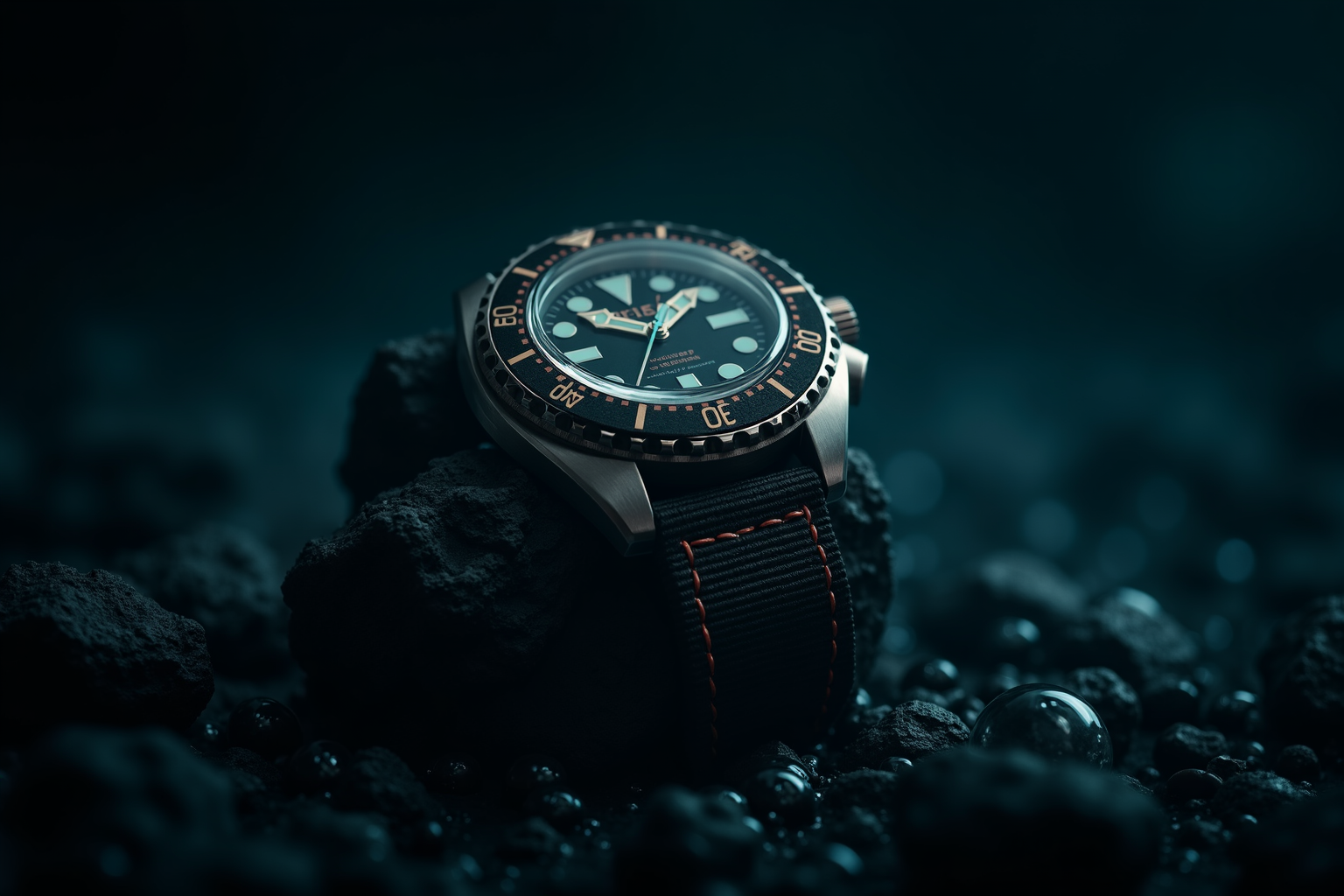

Leave a comment
This site is protected by hCaptcha and the hCaptcha Privacy Policy and Terms of Service apply.