
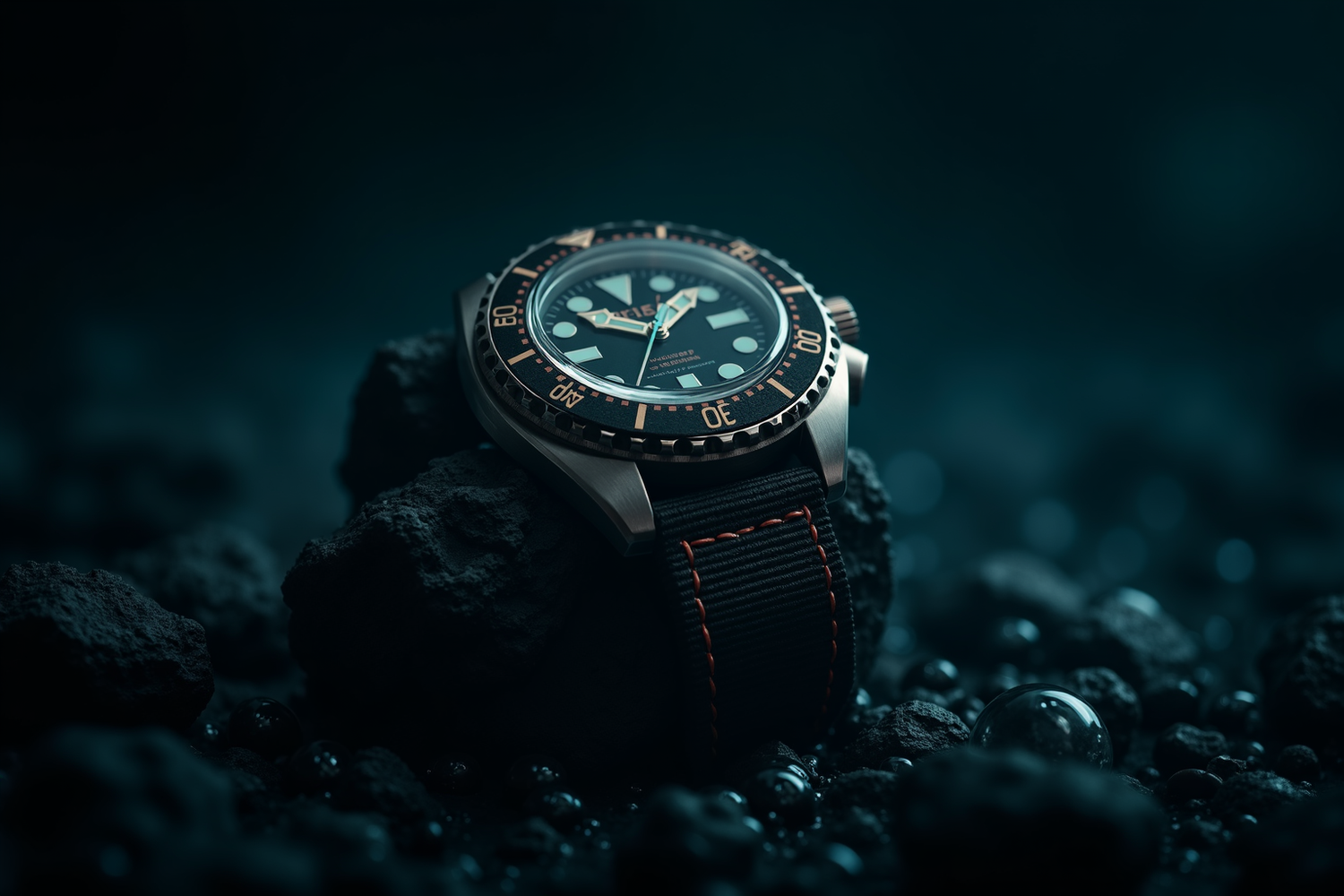

Long before smartphones told us the time and depth gauges shouted it in digital red, divers depended on a small mechanical instrument strapped to their wrist. The dive watch is one of horology's great success stories — a tool invented to keep humans alive underwater that somehow became one of the most worn, most copied, and most beloved categories of luxury timepiece on earth. Its history is a chain of solved problems: water, pressure, gas, darkness, and finally, taste.
The Problem That Created the Dive Watch
For most of horology's history, water was a watch's worst enemy. Cases were assembled from press-fit components, crowns were unsealed, and a single splash could fog a crystal or rust a movement overnight. Sailors and military divers in the early 20th century had to choose between knowing the time and keeping their watches alive.
That changed in 1926, when Hans Wilsdorf — the founder of Rolex — patented the Oyster case. By threading the caseback, bezel, and crown into a single hermetically sealed unit, Wilsdorf created the first commercially viable waterproof wristwatch. To prove it, he had English Channel swimmer Mercedes Gleitze wear one around her neck on a ten-hour crossing in October 1927. The watch survived. Marketing history was made.
But waterproof and dive-ready are not the same thing. A true dive watch needs to survive sustained pressure, not just splashes — and it needs to do something a normal watch cannot: tell its wearer, at a glance, exactly how much breathable time remains.
1953: The Year Modern Diving Was Born
Two watches arrived almost simultaneously in 1953 and effectively defined the category that still exists today: the Blancpain Fifty Fathoms and the Rolex Submariner. Both featured the now-canonical formula — a rotating bezel marked in 60 minutes, large luminous indices, an automatic movement, and water resistance well beyond recreational depths.
The rotating bezel was the breakthrough. Before a dive, the wearer aligns the bezel's zero marker with the minute hand. As time passes, the minute hand sweeps across the bezel's scale, displaying elapsed bottom time directly. Critically, the bezel only rotates counterclockwise — so if it's accidentally bumped during the dive, it can only shorten the perceived remaining air supply, never lengthen it. That single design decision has saved lives. It is also one of the most elegant pieces of safety engineering in any consumer product.
What Makes a Watch Actually Dive-Capable?
The international standard ISO 6425 defines what a watch must do to legally call itself a "diver's watch." The list is more demanding than most people realize:
- Minimum 100m water resistance, tested at 125% of rated depth
- Unidirectional rotating bezel with clear minute markers
- Legibility at 25cm in total darkness
- Magnetic resistance, shock resistance, and resistance to saltwater corrosion
- An end-of-life indicator for the seconds hand (you need to know the watch is still running)
- A strap or bracelet that won't fail under tension
Watches that merely claim "200m water resistant" are not, by themselves, ISO-certified divers. The distinction matters more than the marketing usually admits.
The Helium Escape Valve: Solving a Problem You'd Never Imagine
In the 1960s, professional saturation divers began living for days inside pressurized habitats filled with a helium-oxygen breathing mix. Helium atoms are tiny — far smaller than the rubber gaskets sealing a watch case can reliably block. Over the course of a multi-day saturation dive, helium gradually seeps into the watch.
The problem appears during decompression. As the diver returns to surface pressure, the helium trapped inside the case can't escape fast enough. Internal pressure builds. Crystals pop off. Watches are destroyed not by water pushing in, but by gas pushing out.
The solution, co-developed by Rolex and Doxa in the late 1960s, was the helium escape valve — a tiny one-way pressure valve mounted on the case side, typically at 9 o'clock, that vents helium during decompression while remaining sealed against water. It is one of the most specialized complications in horology, useful to perhaps 0.01% of the people who own watches that have it. And yet it remains a point of pride on a true professional diver.
Materials Built for Saltwater
The interior of a dive watch is mechanical poetry; the exterior is industrial chemistry. Standard 316L stainless steel handles most recreational diving, but serious dive watches now use 904L steel for superior chloride resistance, or titanium for its combination of corrosion immunity and lightness. Cases are sealed with multiple gaskets — usually nitrile or Viton — and crowns are typically screw-down designs with O-rings at every contact surface.
Bezel inserts have evolved from painted aluminum to scratch-resistant ceramic, which holds its color even after decades of UV exposure and saltwater. The lume on the dial and hands — almost always Super-LumiNova or a similar strontium aluminate compound — must charge quickly under boat lights and glow for the full duration of a dive.
Underneath all of it sits a movement that has to survive shocks, magnetism, and the slow pressure cycle of repeated dives. The mechanical complexity hidden inside a serious dive watch is one of the reasons collectors gravitate toward the category — these aren't just watches that look rugged. They're engineered to be.
From Tool to Icon
Somewhere between Sean Connery wearing a Submariner in Dr. No in 1962 and Steve Zissou's Seiko in 2004, the dive watch made a quiet transition from professional instrument to cultural artifact. Most dive watches sold today will never see deeper than a hotel pool. The category survives — and thrives — because the design language it pioneered turned out to be one of horology's most universally appealing: legible, robust, masculine without being aggressive, and at home with both a wetsuit and a suit jacket.
That versatility is also why independent watchmakers continue to reinterpret the dive watch. Strip away the "professional" marketing and you're left with a set of design constraints that produce remarkably honest watches: a clean dial, a functional bezel, real lume, and a case built to last. There's a reason it's one of the few categories where a $300 watch and a $30,000 watch can share the same fundamental architecture.
Featured Watch
TORQ Mechanical Titanium
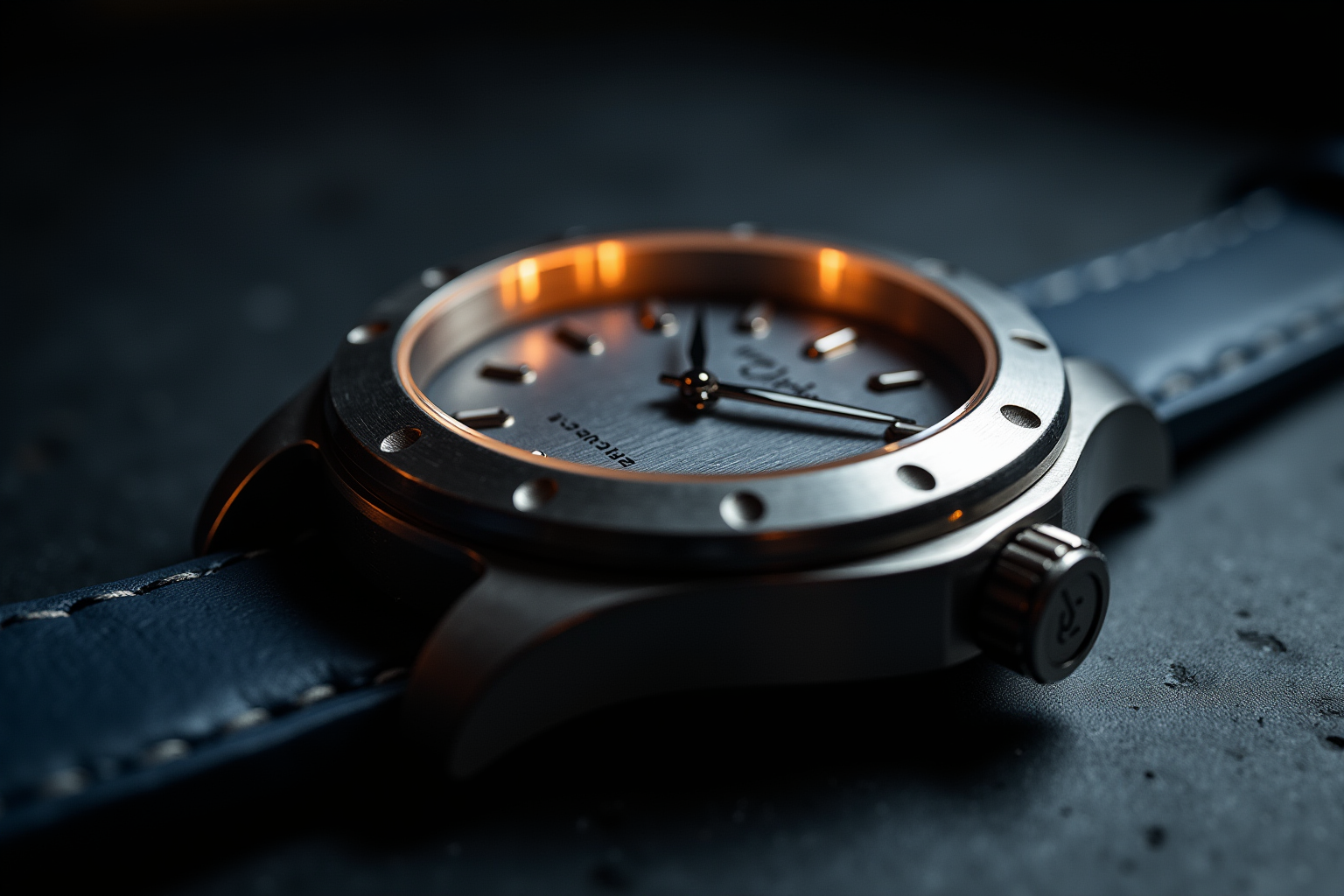
The dive watch was built around materials that survive the ocean. The TORQ Titanium carries that engineering DNA forward — a corrosion-resistant, shock-tolerant case built for environments far beyond a desk.
Explore TORQ Titanium →Why the Dive Watch Still Matters
Modern dive computers are smaller, more accurate, and far more informative than any mechanical watch could ever be. No serious technical diver relies on a wristwatch for primary timing anymore. And yet sales of mechanical dive watches keep climbing. Why?
Partly nostalgia. Partly aesthetics. But mostly, I think, because a dive watch represents something rare in modern objects: a piece of equipment whose form was dictated entirely by function, and whose function happened to produce an enduringly beautiful design. The 60-minute bezel. The luminous indices. The screw-down crown. The unidirectional click. None of it was decorative when it was invented. All of it became iconic anyway.
That's the quiet trick of great industrial design. You solve a problem so well that the solution outlives the problem itself. The dive watch was built to keep us alive underwater. It ended up doing something almost more impressive — it taught horology how to be tough, legible, and beautiful all at once. And nearly a century after Wilsdorf threaded that first Oyster case shut, watchmakers are still building on the foundation he created.

Leave a comment
This site is protected by hCaptcha and the hCaptcha Privacy Policy and Terms of Service apply.