
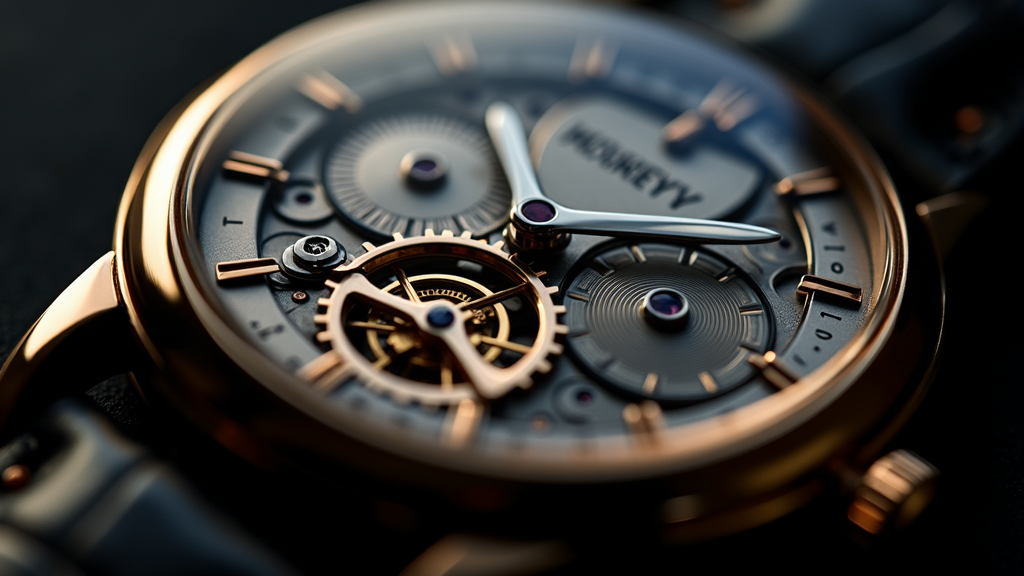
Most chronographs answer one question: how long did something take? The split-seconds chronograph — the rattrapante, from the French for "to catch up" — answers two at once. It can time two events that start together but end apart, and it does so with a mechanism so finicky that even today only a handful of workshops attempt it in-house. To watchmakers, it sits in the same conversation as the tourbillon and the minute repeater: not because it is useful in the smartphone era, but because it is brutally hard to do well.
What a Split-Seconds Chronograph Actually Does
A standard chronograph has one center-mounted seconds hand you start, stop, and reset. A split-seconds chronograph has two stacked seconds hands that sit perfectly overlapped at rest, looking like one. Press start and both sweep together as a single hand. Press the second pusher — usually set into the crown or at two o'clock — and one hand freezes while the other keeps running.
You read the frozen hand for a split or lap time, then press again and it instantly snaps forward to "catch up" with its still-running twin, resuming as if it had never stopped. That catch-up jump is the whole magic, and the whole problem.
The Classic Use Case
Imagine timing two runners in a race. Both start at the gun, so you start the chronograph. The first runner crosses the line — you split one hand to record their time while the other keeps timing the second runner. Read the time, then release, and the split hand leaps back into formation to catch the leader's elapsed time. One watch, two finishers, no second stopwatch required.
The Mechanism: Two Hands, One Heartbeat
Underneath the dial, the split-seconds complication is a study in controlled friction. The two seconds hands ride on two concentric wheels. The lower one is driven by the chronograph train as normal. The upper, the split wheel, is connected to it not by gears but by a delicate heart-shaped cam and a pair of pincer-like clamps called the split-seconds pliers or isolator.
When both hands run together, a tiny ruby roller rides in the valley of that heart cam, and a spring keeps the split wheel locked to the main wheel so they turn as one. Press the rattrapante pusher and the pliers clamp shut on the split wheel, stopping it dead — while the main wheel keeps spinning underneath, the ruby roller now sliding along the heart cam's flank. Release the pliers and the spring-loaded roller drops back into the heart's notch, instantly yanking the split hand to the exact position of the running hand. That snap is mechanical reunification at full speed.
Why It Punishes Watchmakers
The difficulty is in the balance of forces. The clamp must grip the split wheel firmly enough to hold it still, but not so firmly that it disturbs the running hand's amplitude when it grabs on. If the pliers are too tight, the balance loses energy and the watch's timekeeping drifts every time you split. If they are too loose, the frozen hand creeps. The heart cam must be polished to a mirror so the roller returns to dead center without bounce. Every surface fights every other surface.
This is why a rattrapante module can add dozens of components to an already complex chronograph, and why adjusting one is considered a graduation exercise for finishing watchmakers. There is no software shortcut; it is geometry, spring tension, and hand-finishing in equilibrium.
For collectors who appreciate this kind of mechanical theater — complications you can watch perform — our center tourbillon lives in the same spirit: engineering you wear precisely because it is hard.
A Short History of Catching Up
The idea predates the wristwatch. In 1831, Austrian watchmaker Joseph Thaddeus Winnerl built an early double-hand system for timing astronomical events. By the 1880s, makers had refined pocket-watch rattrapantes for scientific and sporting use, when measuring two simultaneous phenomena was a genuine professional need — horse races, regattas, laboratory experiments.
The complication migrated to the wrist in the 20th century, where it became a benchmark of haute horlogerie. A split-seconds chronograph that also keeps accurate time under repeated splitting signals that a workshop has mastered both the chronograph and the art of frictionless engagement. It is one of those complications that buyers rarely use in daily life but deeply respect on the wrist.
Mono-Pusher, Foudroyante, and Other Cousins
The rattrapante belongs to a family of timing complications that push chronograph design to extremes:
- Foudroyante (flyback lightning seconds): a small hand that whips around a sub-dial once per second in eight jumps, letting you read fractions of a second.
- Flyback: a single press that resets and restarts the chronograph in one motion, prized by pilots who needed to time consecutive legs without losing a beat.
- Mono-pusher: start, stop, and reset all sequenced through a single button — elegance through restriction.
Combine a rattrapante with a foudroyante and you have one of the most demanding wristwatch builds in existence — a watch that catches up and slices the second into eighths.
How to Read the Finishing
If you ever get to inspect a split-seconds movement through a display back, look for the rattrapante hardware: the twin clamps near the chronograph wheels and the small steel heart cam. On a well-made piece, the clamp arms are bevelled and mirror-polished on surfaces that will never touch another part — finishing done purely as a statement of craft. Watch the split hand return when the pusher is released: a clean, instantaneous snap with no jitter is the sign of a properly adjusted isolator. A lazy or stuttering return betrays a complication that looks the part but was never truly dialed in.
Why It Still Matters
No one needs to hand-time two runners anymore. But the split-seconds chronograph endures for the same reason the tourbillon and the minute repeater do: it is a problem that resists automation and rewards patience. It cannot be rushed, cannot be faked, and cannot be appreciated from across a room — only up close, where you can watch one hand chase another and snap back into place in a blink. That, more than any spec sheet, is what mechanical watchmaking is really selling.
Featured Watch
Grandeur Center Tourbillon
Like the rattrapante, the tourbillon is a complication built to be watched perform — mechanical theater engineered precisely because it is difficult.
Explore the Center Tourbillon →








Leave a comment
This site is protected by hCaptcha and the hCaptcha Privacy Policy and Terms of Service apply.