
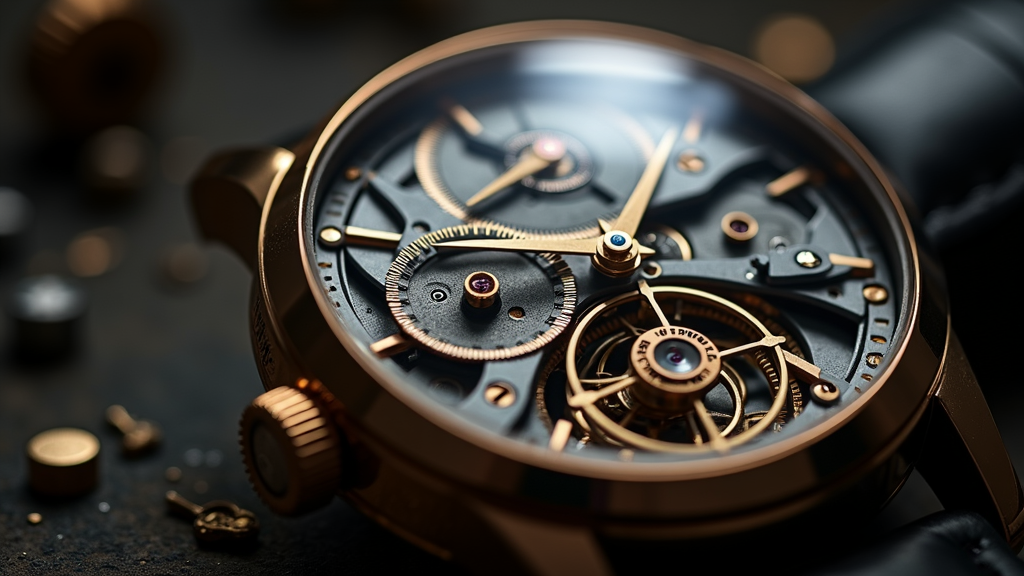
Most watch complications tell you something about the world — the date, the moon, the time in another city. The power reserve indicator is different. It tells you something about the watch itself.
It's the most introspective complication in horology. A small gauge, often crescent-shaped, that quietly reports how much energy is left in the mainspring. No flourish, no fanfare — just a hand creeping slowly from "full" to "empty" over the course of a day or two, reminding you that your watch is alive, and that life, mechanically speaking, is finite.
What Exactly Is a Power Reserve?
To understand the indicator, you have to understand the spring. The mainspring is a coiled ribbon of hardened steel — typically a special alloy called Nivaflex — wound tightly inside a cylindrical container called the barrel. When you wind a watch, you're tensioning that spring. As it slowly unwinds, it releases torque through the gear train, which the escapement meters out in tiny, precise increments. That's how a watch keeps time.
A typical modern mainspring stores enough energy for somewhere between 40 and 80 hours of running. Some marathon movements push past 10 days. The "power reserve" is simply how long the watch will keep ticking before that spring fully relaxes and the watch stops.
The indicator, then, is a fuel gauge. And like any good fuel gauge, it exists because running out unexpectedly is annoying — and, in the case of a fine mechanical watch, slightly disrespectful to the object on your wrist.
A Brief History
The power reserve indicator wasn't born out of luxury. It was born out of necessity, in the deck chronometers used aboard ships in the 18th and 19th centuries. A naval navigator depended on his chronometer for longitude calculations, and a stopped chronometer meant a lost position fix — sometimes a lost ship. Breguet is widely credited with creating early reserve indicators for marine chronometers in the late 1700s, and the complication migrated to pocket watches in the 1800s.
The first wristwatch power reserve indicator is generally attributed to Breitling in the 1930s, though Jaeger-LeCoultre and IWC quickly followed. By mid-century, the complication had become a hallmark of serious tool watches — the kind of watch a pilot, captain, or scientist might actually need to trust.
How the Mechanism Actually Works
Here's where it gets clever. The challenge of a power reserve indicator is that it has to track two opposing motions at once: winding (which adds energy) and running (which subtracts it). Both happen through entirely different parts of the movement.
The classic solution is a differential gear system, the same principle that lets a car's rear wheels turn at different speeds in a corner. One input comes from the winding mechanism — every turn of the crown or rotor adds rotation. The other input comes from the mainspring barrel itself as it slowly unwinds during running. The differential subtracts one motion from the other and outputs the net change to the indicator hand.
It sounds simple. It is not. Squeezing a planetary differential into a movement that's already crowded with the gear train, escapement, and (often) automatic winding module is a serious feat of micro-engineering. The gears involved are sometimes smaller than a grain of rice, and the whole system has to operate with almost no friction — because any friction here means stolen energy from the very reserve it's measuring.
The Linear vs. Sector Debate
Power reserve displays come in two main flavors. Sector indicators use a fan-shaped scale and a moving hand, usually placed at 12, 6, or 9 o'clock on the dial. Linear indicators use a straight track, like a fuel gauge in an old car. Linear is harder to execute mechanically — it requires a rack-and-pinion conversion from rotary to linear motion — but many collectors find it more elegant, more honest. It looks like what it is: a measure of remaining distance.
Why It Matters in an Automatic Watch
Here's a question that comes up a lot: why would an automatic watch need a power reserve indicator? Doesn't it wind itself?
Yes — but only when it's on your wrist. The moment you set it down, the rotor stops. If you wear a watch only on weekdays, or if you have a small collection in rotation, your "automatic" watch is functionally a manual watch for big chunks of its life. A power reserve indicator tells you whether the piece you grabbed off the dresser at 7 AM is going to make it through your dinner reservation, or whether it stopped sometime overnight on Tuesday.
It also tells you something subtler: how efficiently a watch winds. A well-tuned automatic, worn casually, should keep its reserve hovering near full. If you watch it slowly drain over a normal day of activity, the rotor or its bearing may need attention.
The Aesthetic Case
Beyond function, there's something quietly poetic about the complication. Most dial elements show you the present — the time, the date, what is. The power reserve shows you the future, in miniature: how much watch you have left. It's a memento mori for machines.
That's probably why so many independent watchmakers love it. Lange, Laurent Ferrier, Voutilainen, MB&F — almost every serious independent has built a signature piece around an exposed reserve display, often pulling the differential gearing onto the dial side where you can watch it work. The complication invites visual storytelling in a way that, say, a date window simply does not.
What to Look For
If you're shopping for a power reserve watch, a few things separate the great from the merely competent:
- Linearity. A good indicator moves at a constant rate. A cheap one races at the start and crawls at the end. This is a tuning question — and a giveaway about how much engineering went into the differential.
- Reset accuracy. Wind it fully, then unwind. The hand should return precisely to "0" when the watch stops. If it doesn't, the calibration is off.
- Integration. The best power reserve dials don't feel bolted-on. The scale should sit harmoniously with the rest of the dial typography, and the hand should match the time hands in finish and proportion.
- Honesty. Some watches show a slightly inflated reserve to flatter the wearer. The good ones are calibrated conservatively — they tell you "you have 8 hours left" when you actually have 10.
The Independent Approach
At Grandeur, we think about energy and reserve in everything we build — even when there's no visible indicator on the dial. Every in-house movement we make, from the patented jumping hour mechanism in our Strange V3 to the chiming gear train of the Amethyst Whisper Minute Repeater, is engineered with a generous power budget. A complication should never feel like it's stealing from your timekeeping; the spring should always have something left to give.
That's the deeper lesson of the power reserve indicator. It's not really about how long your watch will run. It's about respect — for the machine, for the energy stored inside it, and for the small, honest act of winding it tomorrow morning.
A watch that tells you when it's tired is a watch that trusts you to take care of it.
Featured Watch
Azure Echo 5-Minute Repeater
If the power reserve tells you how much energy your watch has left, the Azure Echo uses every ounce of it: an in-house 5-minute repeater complication that transforms stored energy into pure, resonant sound. Limited to 25 pieces.
Explore Azure Echo 5-Minute Repeater →


Leave a comment
This site is protected by hCaptcha and the hCaptcha Privacy Policy and Terms of Service apply.