
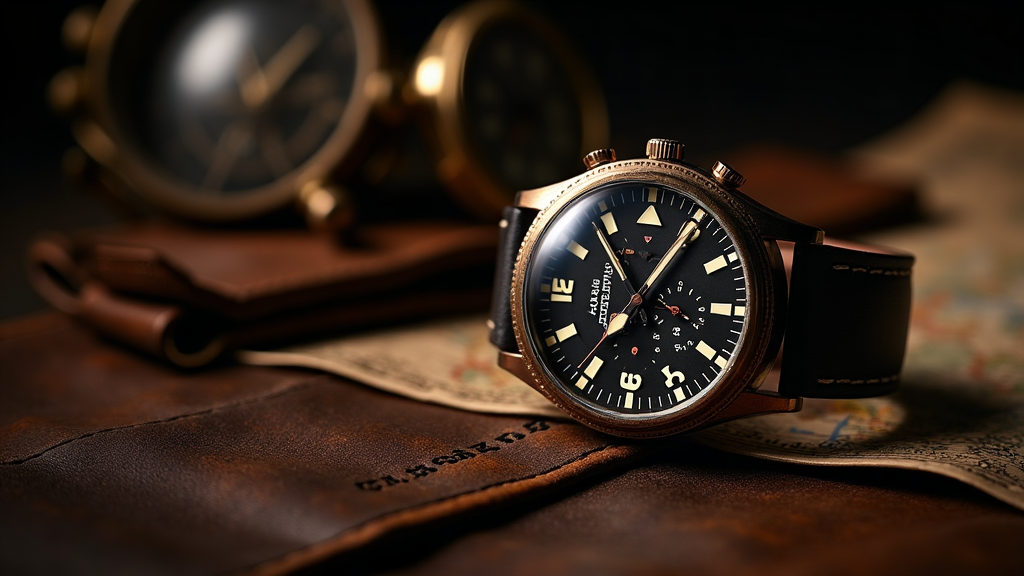
Before there were glass cockpits, GPS, and autopilot, there was a man, a fragile machine, and a watch. In the earliest decades of flight, a pilot's wristwatch was not a luxury or a fashion statement—it was a navigation instrument as essential as the compass and the altimeter. The story of the pilot's watch is the story of how the demands of the sky reshaped what a timepiece had to be: bigger, bolder, more legible, and tougher than anything that came before.
When the Wristwatch Earned Its Wings
The pocket watch ruled the 19th century, but it had an obvious flaw for anyone whose hands were occupied—and few hands were busier than an aviator's. The often-told origin story credits Brazilian aviation pioneer Alberto Santos-Dumont, who in 1904 asked his friend Louis Cartier for a watch he could read without taking his hands off the controls of his flying machine. Cartier's answer, the Santos, is frequently cited as one of the first purpose-built wristwatches for men. Whether or not it was truly the very first, it crystallized an idea: in the air, you needed time on your wrist, instantly.
By the 1910s and 1920s, as aviation matured from daredevil spectacle into a tool of war and commerce, watchmakers began designing specifically for the cockpit. The requirements were unforgiving. Open cockpits meant freezing temperatures and brutal vibration. Navigation by dead reckoning meant a pilot calculated position from speed, heading, and elapsed time—so a watch that ran fast or slow could literally be fatal.
The Anatomy of a Flieger
Out of these pressures emerged a distinct visual language, most famously codified in the German Beobachtungsuhr, or "B-Uhr"—the observation watch issued to Luftwaffe navigators in the late 1930s. These were enormous by the standards of the day, often 55mm in diameter, worn over the sleeve of a flight jacket with an extra-long strap. Everything about them was engineered for split-second legibility.
Oversized Crowns
A pilot wearing thick leather gloves at altitude couldn't fumble with a tiny crown. The solution was the "onion" or diamond-shaped oversized crown—large enough to grip and wind without removing a glove. It remains one of the most recognizable signatures of the pilot's watch aesthetic.
High-Contrast, High-Legibility Dials
Matte black dials with large white Arabic numerals and generous luminous coating became the standard. The triangle marker at 12 o'clock—often flanked by two dots—let a pilot orient the dial at a glance, even in a violently shaking cockpit or dim light. There was no room for decorative flourish; every element existed to be read in a fraction of a second.
Soft-Iron Cores and Antimagnetism
Cockpits were electromagnetically noisy environments, and magnetism is the enemy of accurate timekeeping. Many pilot's watches incorporated a soft-iron inner case to shield the movement—an idea that would later define a whole category of antimagnetic watches for the modern world.
The Tools That Did the Math
As aviation grew more complex, so did the watches. The single most iconic aviation complication is the slide-rule bezel, introduced commercially in the 1950s. By rotating an outer scale against a fixed inner one, a pilot could perform multiplication, division, fuel-burn calculations, airspeed conversions, and unit changes—all on the wrist, mid-flight. It turned the watch into a mechanical flight computer, and its busy, instrument-dense look became shorthand for "serious aviation tool."
The flyback chronograph was another aviation-driven innovation. In navigation, a pilot timing successive legs of a route needed to reset and restart the chronograph in one motion rather than the usual three-step stop-reset-start sequence. The flyback function did exactly that, saving precious seconds when a heading change demanded a fresh timing run.
And as commercial aviation shrank the globe, the cockpit demanded the ability to track multiple time zones at once—a need that gave rise to the GMT complication and, in its most ambitious form, watches that could read time around the entire world simultaneously.
From Cockpit to Culture
By the jet age, the pilot's watch had transcended its purely functional roots. Airlines issued branded chronographs to their crews; military forces standardized their own specifications; and a generation of enthusiasts came to associate the oversized crown and luminous numerals with adventure, precision, and a certain romantic fearlessness. Even as electronic instruments rendered the mechanical pilot's watch technically redundant in the cockpit, its design DNA proved irresistible.
Today the genre is defined more by heritage than necessity. A modern pilot's watch rarely calculates a fuel burn or guides a navigator over the Atlantic. Instead it carries forward a philosophy: that a watch should be honest, legible, robust, and built to be used. The best examples treat that history not as costume but as engineering inheritance—every design choice traceable to a real problem solved at altitude.
Why the Pilot's Watch Still Matters
What makes the aviation watch enduring is that its priorities never went out of style. Legibility under stress, mechanical reliability, resistance to the elements, intuitive operation—these are virtues any serious mechanical watch aspires to. The pilot's watch simply got there first, and most uncompromisingly. It is, in a sense, the purest expression of the tool watch: form dictated entirely by function, beauty arriving as a byproduct of solving real problems.
For the modern collector, a pilot-inspired piece is a connection to the heroic early decades of flight—and a reminder that some of the most beautiful objects we own were born not from a desire to decorate, but from a refusal to fail.
Featured Watch
TorQ Mechanical — Titanium
The same aerospace ethos that defined the pilot's watch lives on in titanium—lightweight, tough, and built to perform under pressure, just like the instruments that once guided aviators across the sky.
Explore TorQ Mechanical Titanium →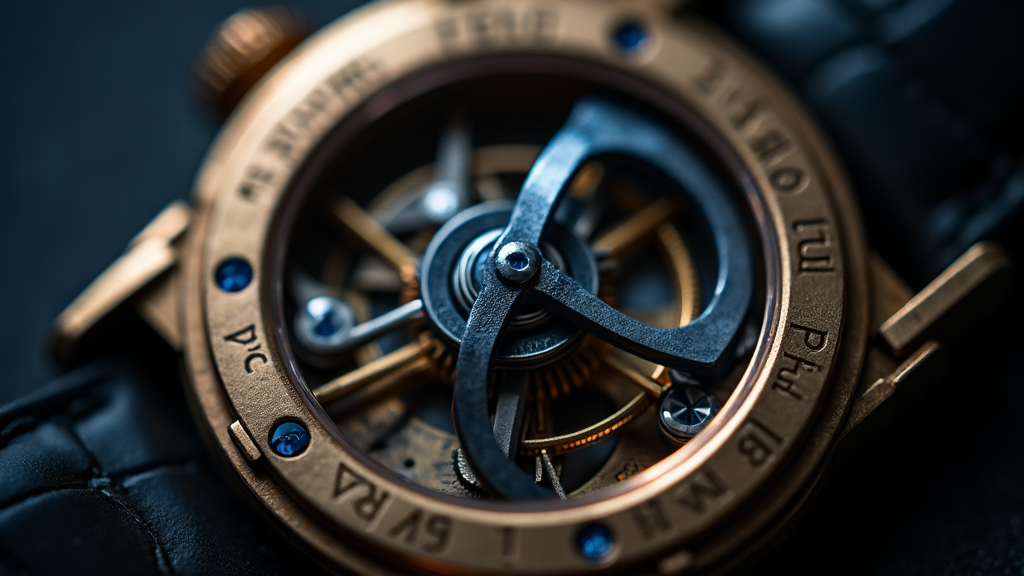

Leave a comment
This site is protected by hCaptcha and the hCaptcha Privacy Policy and Terms of Service apply.