
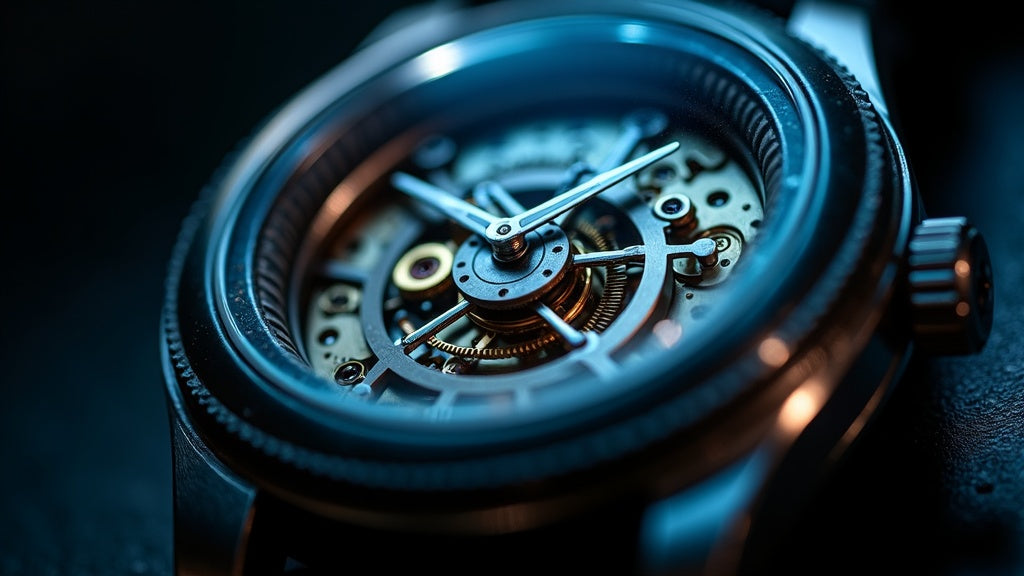
You can't see them, but they're everywhere. Speakers in your headphones, the magnetic clasp on your laptop bag, the induction cooktop, even the back of your phone. Magnetic fields are the invisible weather system of modern life — and they happen to be one of the most underappreciated enemies of a mechanical watch.
For more than a century, watchmakers have been waging a quiet war against magnetism. The story of how they've fought it — and increasingly, how they've won — is one of the most fascinating threads in modern horology. It involves Faraday cages, exotic alloys, silicon hairsprings, and a few moments of genuine engineering brilliance.
Why Magnets Wreck Watches
To understand the problem, you have to look inside. The regulating organ of a mechanical watch — the part that actually decides what time it is — relies on a tiny coiled spring called the balance spring (or hairspring), typically thinner than a human hair. It oscillates back and forth, usually 4 to 5 times per second, and that rhythm is what gets translated into seconds, minutes, and hours.
For most of the 20th century, hairsprings were made of ferromagnetic alloys — primarily steel-based compositions. When such a hairspring drifts close to a magnetic field, the coils briefly stick to one another. The spring effectively shortens, the balance speeds up, and your watch starts running fast. In severe cases, the hairspring becomes permanently magnetized, and the watch can gain anywhere from a few minutes to several hours per day until it's demagnetized at a service.
The modern wrist sees fields a 1950s watchmaker could barely have imagined. A simple refrigerator magnet generates around 50 gauss at the surface. The magnetic latch on a tablet cover can hit 100. An MRI scanner runs at 15,000 gauss and up. By comparison, ISO 764 — the international standard for an "antimagnetic" watch — only requires resistance to 60 gauss. That bar was set in 1966. It hasn't moved since.
The Faraday Cage Approach
The earliest serious solution was beautifully analog: build a metal box around the movement. Inspired by Michael Faraday's experiments in electromagnetic shielding, watchmakers in the mid-20th century began enclosing the movement in a soft-iron inner case. Magnetic field lines prefer to travel through high-permeability metals, so they route around the movement rather than through it.
The most famous example is the IWC Ingenieur, designed by Albert Pellaton in 1955, but the concept reached its purest form in tool watches built for engineers and scientists working near generators, transformers, and early electronics. The Rolex Milgauss (1956) — its name literally meaning "1,000 gauss" — used the same principle, and the Omega Railmaster aimed at railway technicians for the same reason.
The downside of the Faraday cage is what it costs you visually: a closed caseback. You can't see the movement, because the movement is hiding inside an iron tube. For decades, that was the trade-off. Antimagnetism or aesthetics — pick one.
The Silicon Revolution
The real breakthrough didn't come until the early 2000s, and it came from a surprising place: the semiconductor industry.
In 2001, a consortium of Patek Philippe, Rolex, and the Swatch Group, working with the Centre Suisse d'Électronique et de Microtechnique (CSEM), began experimenting with silicon as a hairspring material. Silicon is non-magnetic. It's lighter than steel, harder, more dimensionally stable across temperatures, and — critically — it can be etched with the same Deep Reactive Ion Etching (DRIE) techniques used to make computer chips. That precision is something traditional drawn-wire manufacturing can never match.
Within a decade, silicon escapement components had spread across haute horlogerie. Patek's Spiromax, Rolex's Syloxi, Ulysse Nardin's DIAMonSIL, and Omega's Si14 hairspring are all variations on the same idea. The result: watches that don't just resist magnetism — they're indifferent to it. Omega's Master Chronometer standard now demands resistance to 15,000 gauss. That's MRI territory. You can rest a Speedmaster on a hospital scanner and it will keep running.
Beyond the Hairspring
The hairspring is only one ferromagnetic component in a watch. The pallet fork, escape wheel, and even the mainspring all once contributed to the problem. Modern antimagnetic watches address each:
- Pallet fork and escape wheel: Now frequently made of silicon (LIGA-formed nickel-phosphorus is another approach used by Rolex)
- Mainspring: Replaced by Nivaflex and similar paramagnetic alloys
- Balance wheel: Glucydur (beryllium-copper) replaced steel decades ago — paramagnetic and thermally stable
- Screws and bridges: Increasingly made from non-magnetic alloys or treated for low permeability
What this means in practice is that you can finally have your cake and eat it too. A modern antimagnetic watch doesn't need a closed caseback. You can put a sapphire window over the movement, watch the silicon hairspring pulse like a metronome, and shrug off your AirPods case at the same time.
Where Independent Makers Take It Further
The big maisons have the marketing budgets, but independent watchmakers have always been the ones pushing material science the hardest — because they have to. When you build in small numbers, you can take risks the conglomerates can't justify.
Titanium cases are one quiet example. Grade 5 titanium (TC4) is paramagnetic, meaning it has only the faintest susceptibility to magnetic fields and never retains a charge. Watches built around titanium cases and silicon escapements are essentially immune to anything short of a particle accelerator. Grandeur's LUMILLION Tourbillon, for instance, uses a TC4 titanium case alongside its Damascus aluminum dial — meaning the wearer benefits from both the dramatic visual aesthetic and the hidden practicality of a non-magnetic enclosure.
It's a quiet kind of luxury. You don't see it on the dial. You only notice it when, after a year of MRI machines and induction stovetops and magnetic phone mounts, your watch is still keeping time exactly the way it did the day you bought it.
The Field Test You Don't Want to Do
If you ever suspect your watch has been magnetized — it's running consistently fast by several minutes a day, especially after exposure to a known magnetic source — there's a $20 fix called a demagnetizer. Watchmakers have used them for decades. Place the watch on the unit, press the button, slowly draw it away. The alternating field randomizes the magnetic domains and the watch typically returns to spec.
It's a satisfying piece of physics. But the better answer, in 2026, is to never need one.
What This Means for Buyers
If you're shopping for a watch and antimagnetism matters to you — and given the world we live in, it probably should — look for three things:
- A silicon (or equivalent non-ferrous) hairspring
- A non-magnetic case material (titanium, ceramic, gold)
- An ISO 764 certification at minimum, or better, a Master Chronometer rating (15,000 gauss)
You don't need to chase MRI-level resistance for daily life. But knowing what's inside your watch — and how the industry quietly solved a problem most people don't even know exists — is part of what makes mechanical horology endlessly interesting. A good watch isn't fighting time. It's fighting the modern world. And these days, it's winning.
Featured Watch
TorQ Mechanical — Titanium Edition
The TorQ Mechanical Titanium uses Grade 5 TC4 titanium — a paramagnetic alloy that never retains a magnetic charge. Combine it with a modern silicon-equipped escapement and you have exactly what this article describes: antimagnetism built in from the material up.
Explore TorQ Mechanical — Titanium Edition →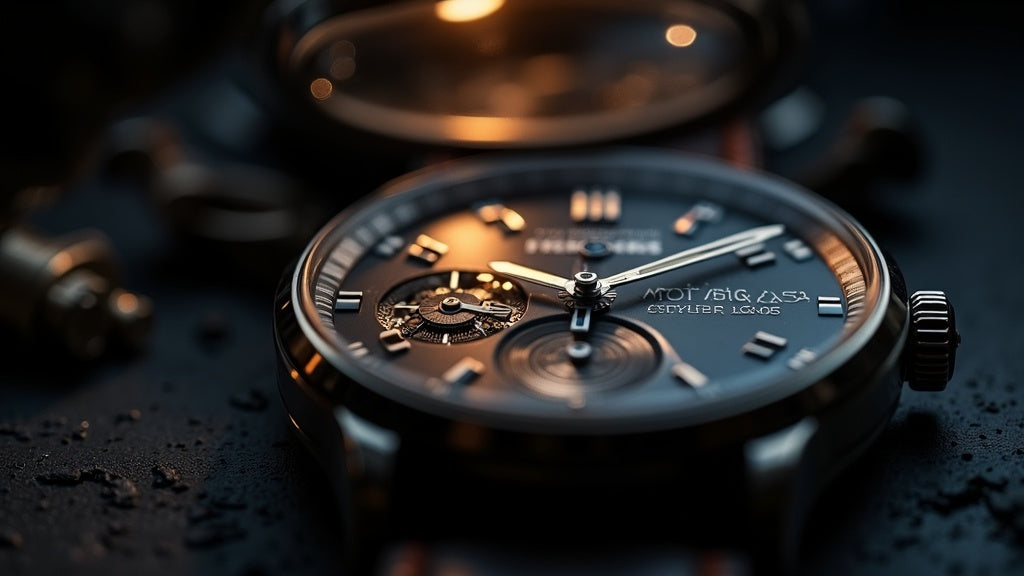

Leave a comment
This site is protected by hCaptcha and the hCaptcha Privacy Policy and Terms of Service apply.