
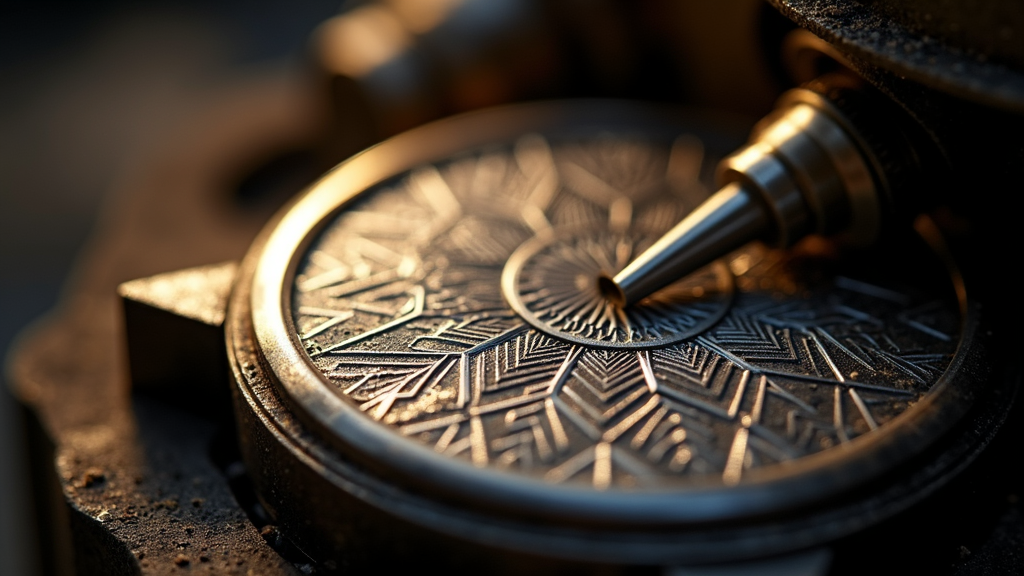
On a quiet afternoon in a Swiss workshop, a craftsman leans into a machine that looks like something out of a steampunk novel. Cast-iron levers, brass cams, a hand crank. He turns it slowly — half a millimeter at a time — and a pattern of impossible geometric perfection begins to bloom across a silver disc the size of a coin. This is guilloché, and almost nobody makes it like this anymore.
What Is Guilloché, Really?
Guilloché (pronounced gee-oh-SHAY) is the art of cutting intricate, repeating geometric patterns into metal using a specialized hand-operated lathe. Look closely at the dial of an A. Lange & Söhne, a Breguet, or a vintage Vacheron and you'll see it: sunbursts radiating from the center, waves of clous de Paris (hobnail), or the unmistakable grain d'orge (barleycorn) crosshatch. Those aren't printed. Those aren't stamped. Every line was physically carved into the metal, one pass at a time, by a rose engine or a straight-line engine turning lathe that was probably built before electric lights reached most of Switzerland.
The word itself likely comes from an Italian engineer named Guillot, who refined the mechanical process in the 1700s, though the technique has roots going back to 16th-century French and German instrument makers. By the time Abraham-Louis Breguet got his hands on the machinery in the late 1700s, he had already figured out what the rest of watchmaking would take another century to appreciate: a guilloché dial doesn't just decorate a watch. It transforms one.
How It's Actually Done
To understand why guilloché is so revered, you have to understand what's happening mechanically. A rose engine lathe holds the dial blank against a rotating pattern template called a rosette. As the operator cranks the machine by hand, the rosette's undulating edge pushes the workpiece in and out against a fixed cutting tool. The result is a pattern that traces the rosette's geometry directly into the metal.
A straight-line engine does something different — it moves the cutter in precise parallel lines, producing patterns like the ribbed sunburst you see on classic Breguet dials. Combining both machines on a single dial — as the best artisans do — can take anywhere from four hours to four days, depending on complexity.
The Margin for Error Is Zero
Here's what separates guilloché from every other dial-finishing technique: you cannot fix a mistake. Once the cutter bites into the dial blank, the metal is displaced. There's no polishing it out, no painting over it. One slip — one sneeze, one moment of hesitation — and eight hours of work go into the scrap bin. Master guillocheurs talk about it the way surgeons talk about first cuts: total focus, steady hands, breathing slowed on purpose.
The depth of the cut is typically between 0.03 and 0.08 millimeters. That's roughly the thickness of a human hair. Deeper and you lose crispness; shallower and the pattern won't catch light. Every pass has to be identical, because the human eye picks up irregularities instantly — not consciously, but in that "something feels off" way that ruins a dial.
Why It Nearly Died
By the 1970s, real guilloché was essentially extinct. The quartz crisis gutted the Swiss industry, and mechanical dial-making was one of the first casualties. Machines that had been passed down through generations were sold for scrap or collected dust in attics. The skills went with them. An entire generation of guillocheurs retired and simply didn't train replacements, because nobody was ordering the work.
What replaced it? Stamped guilloché — essentially a die pressed into the dial to mimic the look. It's faster, cheaper, and if you don't know what to look for, it passes the squint test. But under a loupe, stamped patterns lose that razor-sharp definition at the center of each cut. They're blurry where real guilloché is crisp. The light plays differently — flatter, less alive.
The revival came from two directions: haute horlogerie houses quietly hunting down old rose engines in estate sales, and a handful of independent artisans — Jochen Benzinger, Kari Voutilainen, Brittany Nicole Cox — who decided the craft was worth saving. Today there are probably fewer than 40 true guilloché masters working at a commercial level worldwide. That's not a marketing number. That's reality.
How to Spot the Real Thing
- Look at the center. On true guilloché, the pattern terminates in a clean vanishing point. On stamped versions, the center is mushy or has visible dimpling.
- Tilt the dial under light. Real guilloché shifts dramatically — almost holographically — as light hits it from different angles. Stamped dials have a flatter, more uniform shine.
- Check the cut walls. Under 10x magnification, a hand-cut groove has sharp, vertical walls. A stamped groove has rounded shoulders.
- Feel the price. A real guilloché dial adds anywhere from $2,000 to $15,000 to a watch's retail. If a brand is claiming hand-guilloché on a $3,000 watch, they're almost certainly stamping.
The Patterns and Their Meanings
Guilloché has its own vocabulary, and the names are worth knowing:
- Clous de Paris — Paris hobnail. A pyramid grid that dances in light. Audemars Piguet's Royal Oak made this pattern iconic in 1972.
- Grain d'orge — Barleycorn. A tight crosshatch favored by Breguet; appears almost woven.
- Vagues — Waves. Flowing curves radiating outward. Technically demanding because the rosette has to produce smooth sinusoidal motion.
- Soleil — Sunburst. Straight lines radiating from the center. Deceptively simple; actually among the hardest to execute cleanly because the human eye catches any wobble instantly.
- Panier — Basket weave. Alternating raised and sunken squares that create real dimensional depth.
Why It Still Matters
In an era when a smartwatch can print a different dial every second, spending three days carving one into metal by hand sounds absurd. Maybe it is. But that's the point. A guilloché dial is a small argument — made in silver and brass — that some things should be slow. That precision achieved by human hands carries a weight that precision achieved by algorithm does not. That the object on your wrist should contain evidence of someone's patience.
At Grandeur, we believe the dial is the soul of the watch. That conviction runs through everything from our stone-dial work — like the hand-set 18k Lapis Lazuli Edition, where natural stone replaces metal but the philosophy stays the same — to the architectural finishing on our mechanical pieces. Different materials, same refusal to let the most visible surface of a watch become an afterthought.
Next time you look at a luxury watch, do yourself a favor: get close. Tilt it. Watch the light move. If the dial is alive — if it shifts and breathes as the angle changes — you're looking at the last surviving evidence of a 300-year-old conversation between a human hand and a piece of metal. That's worth slowing down for.
Featured Watch
18K Lapis Lazuli Edition
Grandeur's 18K Lapis Lazuli Edition applies the same philosophy as guilloché: let the material do the talking. Each dial is cut from genuine Afghan lapis lazuli — ancient, irreplaceable, and alive with golden pyrite.
Explore 18K Lapis Lazuli Edition →

Leave a comment
This site is protected by hCaptcha and the hCaptcha Privacy Policy and Terms of Service apply.