
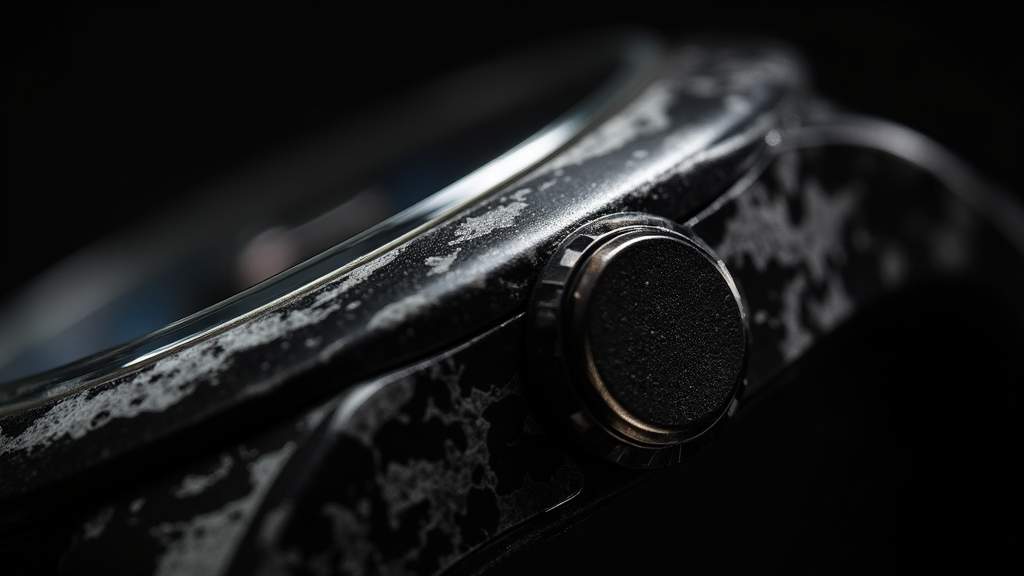
Carbon fiber has been lurking in the backstage of high-performance engineering for decades — wrapped around Formula 1 monocoques, baked into fighter jet fuselages, and woven into everything from tennis rackets to Mars rovers. But when watchmakers started using it, something strange happened. They didn't want the neat, orderly weave the aerospace guys loved. They wanted chaos. They wanted forged carbon.
If you've ever seen a watch case that looks like cracked obsidian or a slab of dark volcanic marble, you've seen forged carbon. It's one of the most visually striking materials in modern horology — and one of the most technically demanding to make. Here's why it matters.
What Exactly Is Forged Carbon?
Traditional carbon fiber is made by weaving long filaments of carbon into a fabric, layering those sheets, and impregnating them with resin. The result is that familiar cross-hatched pattern you see on supercar hoods and expensive bike frames. It's light, strong, and extremely directional — the weave dictates how the material behaves under stress.
Forged carbon throws that playbook out the window. Instead of neat weaves, short strands of carbon fiber — typically just a few millimeters long — are mixed into a resin slurry. The mixture is then poured into a mold and subjected to enormous pressure and heat. Under thousands of PSI, the resin flows, the fibers lock in whatever orientation they happen to be in, and the whole thing hardens into a solid block.
The result is a material with no grain direction. Strength is distributed isotropically — meaning it performs equally in all directions. And because the fibers freeze in place chaotically, every single piece of forged carbon has a completely unique pattern. No two watches made from it will ever look exactly alike.
The Lamborghini Origin Story
Forged carbon was popularized in the automotive world by Lamborghini in the mid-2000s, who used it to replace aluminum in the Sesto Elemento. The material was 20% stronger than traditional woven carbon and significantly lighter. Audemars Piguet saw the potential and introduced the first forged carbon watch case in the Royal Oak Offshore in 2007 — and the rest of the industry has been catching up ever since.
Why Watchmakers Love It
Forged carbon hits a rare trifecta that's hard to achieve with any other material:
- Weight: It's roughly one-third the weight of steel and about half the weight of titanium. On the wrist, a forged carbon watch feels almost weightless — the kind of sensation that makes you check to confirm you're still wearing it.
- Hypoallergenic: Because it's a polymer composite, there's no nickel, no chromium, none of the common metal allergens. Skin-sensitive collectors can wear it all day.
- Corrosion-proof: Carbon doesn't rust, tarnish, or react with sweat, saltwater, or chlorine. It's effectively immune to the things that eat stainless steel alive over time.
- Heat resistant: Forged carbon holds its shape at temperatures that would warp plastics and certain alloys.
- Uniqueness: That marbled, swirling pattern is the horological equivalent of a fingerprint. Your watch is genuinely one of one.
The Downsides (Yes, There Are Some)
Forged carbon isn't magic. It's significantly more expensive to produce than stainless steel — the molds are costly, the presses are specialized, and the reject rate during production is high because voids and air pockets ruin pieces. It's also softer than sapphire or ceramic, so it can scratch more easily than you'd expect for such a "high-tech" material. And unlike metal, you can't really polish out a deep gouge — the pattern is part of the material itself, not a surface finish.
It's also heavier to machine well. The fibers chew through cutting tools, and getting clean edges on a forged carbon case requires diamond-tipped tooling and a lot of patience. Which is why most brands using it are either very small and very patient, or very large and very expensive.
Reading the Pattern
One of the simple pleasures of owning a forged carbon watch is learning to "read" the pattern. Because the fibers freeze at random, you can sometimes see flow lines where the resin moved under pressure, tight whorls where fibers bunched together, and long sweeping streaks where they aligned by chance. Hold it under different light and the grey flecks shift and shimmer — it's a bit like looking at damascus steel, or the grain in a piece of burled walnut.
Some collectors spend hours examining their pieces this way. There's no "right" pattern. A piece with dramatic contrast and long fiber streaks might be striking; one with a subtler, more uniform texture might feel more refined. Part of the fun is that you have almost no control over what you end up with — you're essentially buying a piece of geology that happens to tell the time.
Forged Carbon Done Right
Because forged carbon is so lightweight, it pairs beautifully with thin, high-complication movements. A heavy tourbillon in a steel case can feel like a small dumbbell; the same movement in a forged carbon case becomes almost spectral on the wrist. It's why independent brands — especially those making ultra-thin pieces — have been leaning into the material hard.
Our own TorQ Mechanical Forged Carbon is a case study in this philosophy. The TorQ is already one of the thinnest mechanical watches in its class, and pairing that slim profile with forged carbon produces something that genuinely disappears on the wrist. We offer it in both luminous and non-lume variants — the luminous version uses forged carbon infused with photoluminescent compounds that glow from within the material itself, not just from a coating. Every single case is visually unique, and the pattern is baked in forever.
The Bottom Line
Forged carbon is one of those materials that feels genuinely futuristic without resorting to gimmicks. It's not just "carbon fiber with extra steps" — it's a fundamentally different way of building a watch case, one that trades the predictable order of a weave for the wild, organic beauty of frozen chaos. Whether that appeals to you probably says something about your relationship with watches in general. If you want your timepiece to look exactly like everyone else's, get stainless steel. If you want something where the universe had a hand in the final design, forged carbon is waiting.
It's the rare material that satisfies the engineer, the artist, and the collector all at once. That's a hard trick to pull off — and the reason we'll be seeing a lot more of it on wrists in the years to come.
Featured Watch
TorQ Mechanical — Forged Carbon Edition
Every TorQ Mechanical Forged Carbon case has a pattern no other watch on earth shares — frozen chaos under sapphire crystal. Available in Luminous and Non-Lume variants; the lume version glows from within the material itself.
Explore TorQ Mechanical — Forged Carbon Edition →

Leave a comment
This site is protected by hCaptcha and the hCaptcha Privacy Policy and Terms of Service apply.